Experimental stage: basic laboratory research on early human embryos. This was not a clinical trial of pregnancy, birth, or treatment outcomes. This explanation draws on Nature’s peer-reviewed early-release article published on September 9 and the research institutions’ accounts.
#1. The conclusion in one sentence
Successfully changing the intended DNA letter does not guarantee that everything else remains intact. The central lesson of this human-embryo study is that high editing efficiency and safety for reproductive use must be evaluated separately.[1]
#2. Why this problem is difficult
Imagine DNA as a long instruction manual. Its four kinds of bases, A, T, G, and C, are the letters. A gene is a functional stretch of that sequence, while a chromosome is a structure in which DNA is packaged with proteins. The complete genetic information is the genome. This analogy is only an aid to understanding; it does not mean one gene independently determines one trait.[4]
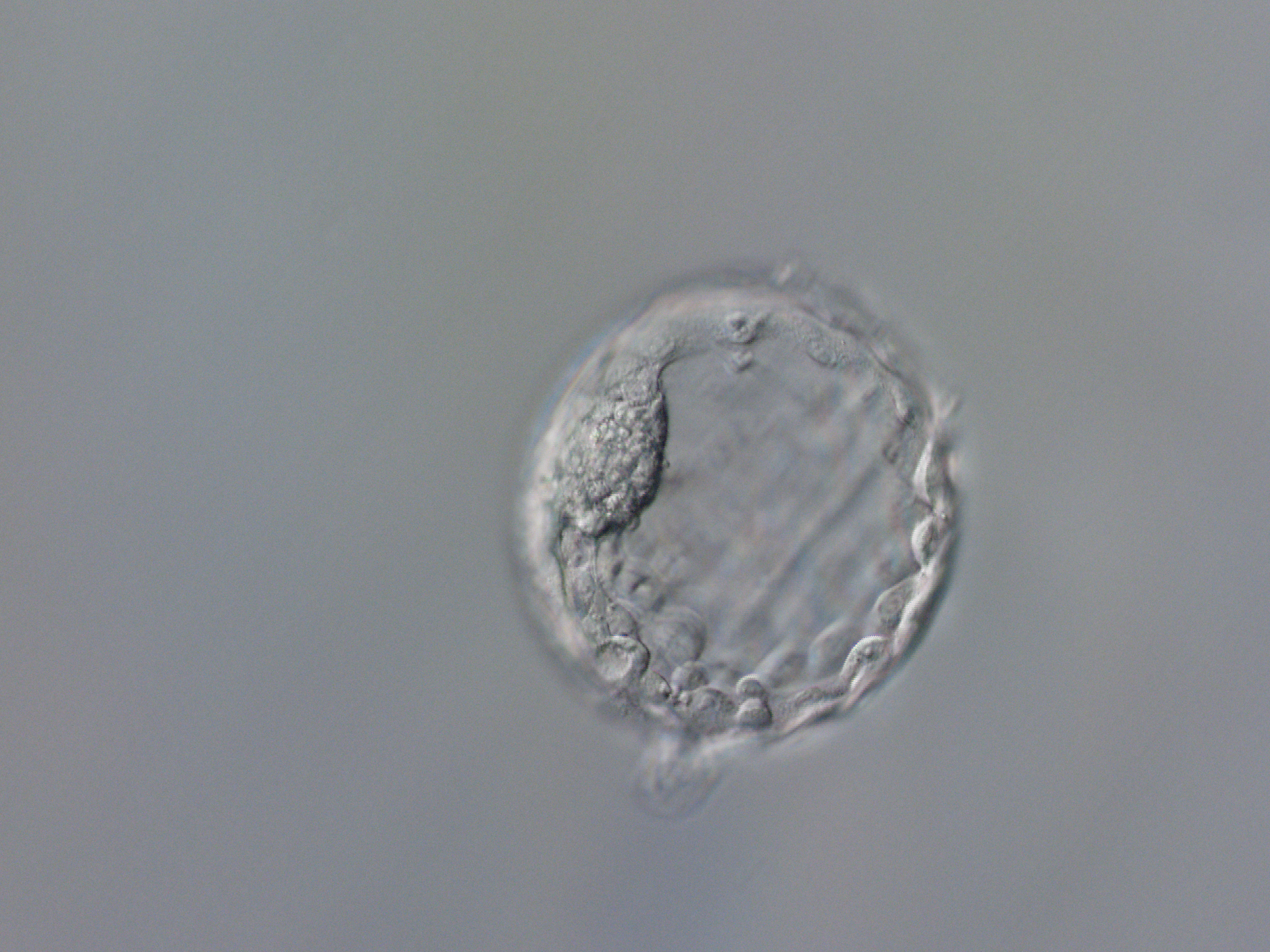
An embryo is an organism at an early developmental stage after fertilization. The single cell formed when sperm and egg unite, the zygote, divides and increases its cell number. This study observed development to approximately 6–7 days after fertilization. A blastocyst at that stage has a cavity and distinct groups of cells; it is not a miniature baby.[2][3]
An early edit or error can therefore be passed to multiple subsequent cells. Checking the intended letter alone is not enough.
#First distinguish the letters, passages, and packaged volumes
DNA, genes, and chromosomes are not interchangeable names for differently sized objects. DNA is a molecule, a gene is a functional region within it, and a chromosome is a structure made of DNA and proteins. “A gene was edited” does not tell us exactly what changed. Was one letter substituted, a segment deleted, or the activity of a region altered? The distinction resembles correcting a typo versus deleting a paragraph.[4]
An allele is a version of the DNA sequence at a particular location. At a typical autosomal locus, there are two copies, usually one inherited from each parent. Matching versions are described as homozygous; different versions as heterozygous. This is a general explanation, not a claim that every cell and chromosome always has two copies. When a paper says “all alleles,” the locus and the samples tested must be specified.[4]
#Why division of the zygote matters
Consider an imaginary document-copying process. Edit the original before making copies, and the copies may share that edit. Start copying first and edit only some copies, and their contents differ. In early embryos, the timing of editing relative to division likewise matters. Living cells are not photocopiers that transmit every change identically, so this analogy explains timing rather than fully describing development.
Many developmental steps separate a blastocyst from a child after birth. A microscopy image can show that an early structure formed, but not the future function of every organ or lifelong health. This distinction is especially important when interpreting a 6–7-day observation period. “Normal development” must be read together with what was measured and when.[2][3]
#3. What was missing from the previous approach
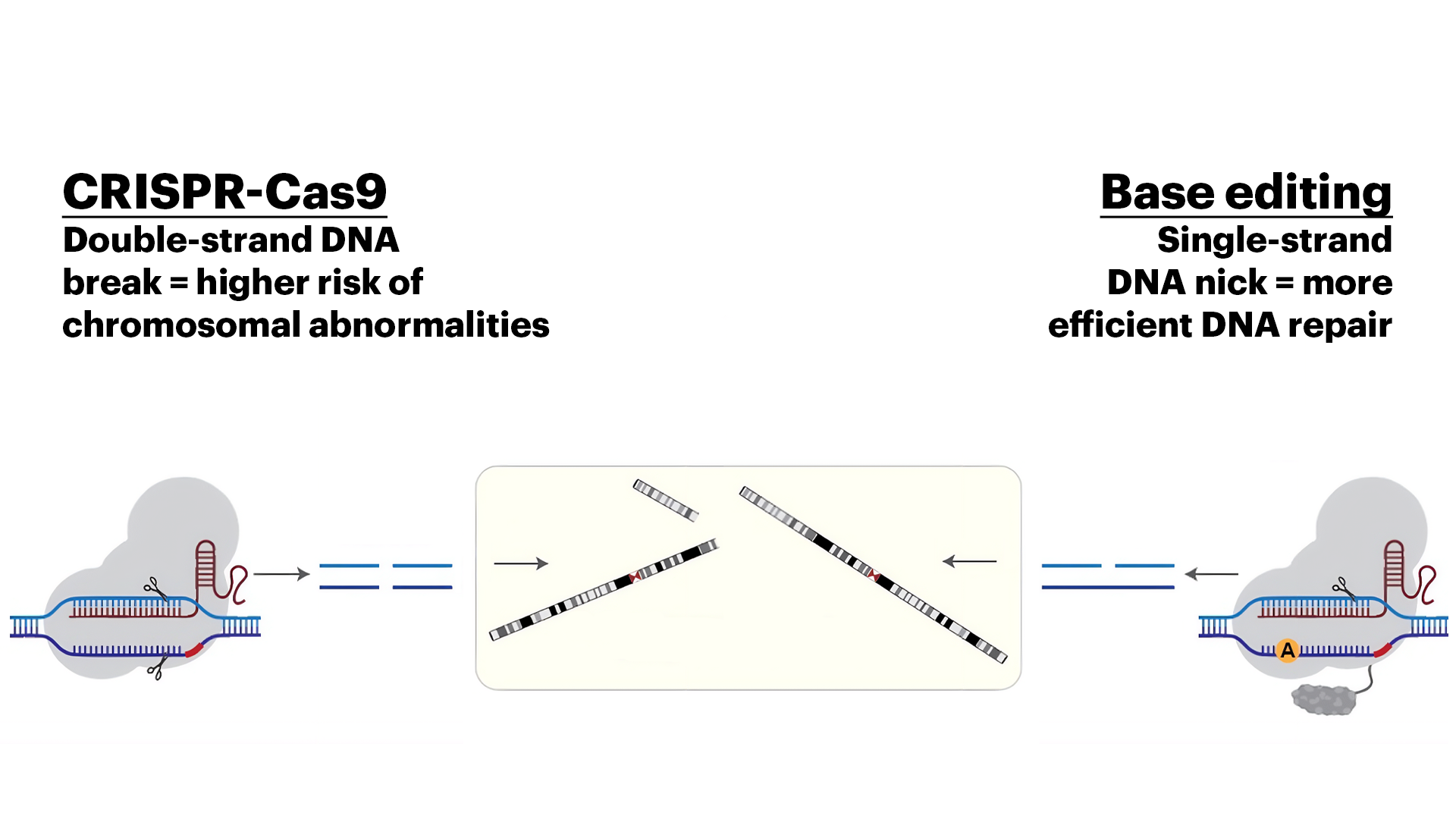
Some conventional CRISPR-Cas9 approaches cut both DNA strands and rely on the cell to repair them. It is rather like cutting through both sides of the instruction manual and joining them again to fix a letter. In early human embryos, repair can go wrong, producing large deletions or chromosome abnormalities.[1]
Base editing changes the chemical state of a particular base without cutting both strands. The adenine-editing family studied here ultimately changes an A–T base pair to G–C. However, the tool also makes a small cut in one strand. Calling it a “pencil” does not mean it causes no damage.[1][3]
#What the scissors-and-pencil analogy hides
“A pencil is safer than scissors” can start a comparison, but cannot settle it. Even when a change resembles precise letter correction, chemical modification and cellular repair are involved. Unintended letters may change, and repair may not proceed as expected. What matters is the DNA change that actually occurs, not the tool’s nickname.[1][3]
The process can be separated into finding the target, making a change there, and the cell’s response to that change. Finding the right house on a map does not guarantee a successful repair inside it. Likewise, accurate targeting must not be confused with reaching the desired final state without damage. This is a conceptual distinction, not a procedure or set of conditions for editing human embryos.
A nick is a break in one of the two strands. It differs from a double-strand break, but does not mean that nothing happened. Different changes can require different cellular responses. That is why the paper is informative about DNA repair in early embryos, not merely a contest between editing tools.[3]
#4. The new approach in three steps
First, the researchers examined editing outcomes in early embryos at targets including PCSK9. PCSK9 is involved in regulating blood LDL cholesterol. Editing it is not the same as demonstrating treatment of a disease.[2]
Second, they compared delivering the editor as a protein with delivering it as mRNA. The former resembles supplying a finished tool; the latter resembles supplying instructions so that the cell makes the tool.[3]
Third, they examined embryo development and unintended genetic changes as well as the intended edit. An important question was how the embryo repairs different kinds of damage, not only whether the editor works.[1][3]
#What must a useful experiment compare?
Match each question to its measurement. Determining whether the intended letter changed requires analysis of the target sequence. Determining whether other locations remain intact requires a different scope of analysis. Determining whether the embryo developed requires developmental observation. Assuming one test answers all three can lead to an incorrect conclusion from an otherwise interesting result.
A control provides the reference for comparison. Without knowing what was compared, it is difficult to attribute an observed difference to the editor. When comparing delivery methods, for example, one should check which other conditions—developmental stage, observation time, and so on—were held comparable. This is a guide to reading experiments, not an assertion that every group in this paper had perfectly identical conditions.
The difference between protein and mRNA delivery can be understood as handing over a finished tool versus instructions for making one. With the instructions, the cell produces the tool, so its amount and duration of activity also matter. This study cannot establish that every mRNA medicine is dangerous or every protein delivery method is safe. Extending the result to technologies with different targets, substances, and purposes would exceed its scope.[2][3]
#5. Key experiments and numbers
The abstract reports editing of all PCSK9 alleles, blastocyst development, and establishment of edited stem-cell lines under a particular protein-delivery condition. Alleles are versions at the same genetic location, generally inherited from each parent.[1][4]
This does not mean every experimental embryo was safe. The abstract also records rare on-target chromosome breakage and chromosome abnormalities. Embryo developmental arrest was reported frequently with mRNA delivery.[1]
Another result concerns mosaicism: cells descended from the same zygote have different genetic changes. Editing near the target and at other locations showed this pattern in the study.[1][4]
#Find the denominator before reading “100%”
In an imaginary experiment, if all 10 tested target copies changed, the editing rate for those copies could be called 100%. That would not mean 10 embryos were tested or that every location across the genome was examined. The number 10 is invented solely to explain a proportion; it is not this paper’s sample size. Always ask what was counted.
“100% under some conditions” also differs from “100% under all conditions, every time.” Identifying an effective condition is valuable, but whether it generalizes to another target or set of samples remains a separate question. Headlines can make the two statements sound similar. Listing the experimental group, unit of analysis, and observation time often reveals what has been omitted.
Mosaicism cannot be understood from an average alone. Imagine two cells with the same intended edit but different changes elsewhere. Uniformity at the target is therefore not the same question as uniformity across the genome. Mosaicism can involve changes ranging from individual DNA letters to chromosome number, and it does not invariably cause disease.[4]
Establishing a stem-cell line also requires careful interpretation. A cell line is a population maintained and analyzed in the laboratory. Continuing to study cells derived from an embryo is useful for obtaining genetic material and conducting further analysis. It is not equivalent to fully evaluating every original cell and every future tissue. IOCB explains that the derived stem cells enabled more detailed analysis in this study.[3]
#6. Limitations and counterevidence
Bystander editing, which changes other letters near the intended one, differs from off-target editing, which changes another genomic address. Both must be examined even when the intended edit succeeds.[1]
Development to the blastocyst stage cannot determine health after birth. This article does not provide group-by-group sample sizes or abnormality rates because the original tables were not fully cross-checked. Mosaicism does not always mean disease, but it makes the outcome of reproductive use harder to predict.[2][4]
Some authors disclosed relationships with genetic-testing or therapeutic-technology companies. These do not invalidate the results, but are relevant context for the importance of independent replication.[2]
#“Not detected” is not the same as “does not exist”
Safety assessment has a measurement boundary. Looking closely at one location may miss large changes elsewhere; pooling cells may obscure differences between individual cells. This is not an allegation that the paper missed a particular error. It means every test has a scope. A useful review distinguishes what a measurement shows from what it cannot guarantee.
A detection limit marks the boundary of what a test can distinguish. Even when no problem is observed, excluding very rare events depends on sample size and measurement method. “Zero observed errors” should prompt the questions “how many were examined?” and “how closely?” That is why this article does not invent probabilities for rare errors or propose a safe threshold without checking the experimental tables.
This explanation is not an independent validation report reanalyzing all of Nature’s tables and supplementary data. It separates results confirmed in public research accounts, basic terminology, and editorial interpretation. It does not invent controls or failures, and it does not assume that information we could not verify is absent from the paper. Medical conclusions should not be stronger than the verified institutional accounts support.
Ethics is not another name for technical success rate. The permitted scope of basic research, reproductive use, and interventions affecting future generations are different questions. Lower technical risk would not automatically settle social and ethical issues. IOCB describes this as basic research conducted under ethics oversight; that does not mean reproductive editing is authorized in every country.[3]
#7. What could actually change
The nearer-term contribution is to early-development research, not “gene-edited babies.” Stem cells derived from edited embryos can help investigate DNA damage and repair in more detail. Such knowledge could assist future IVF research, but clinical improvement has not already been demonstrated.[3]
#Research tools and treatment tools have different kinds of value
A treatment needs evidence of benefit to patients and an assessment of risk. A research tool can be valuable because it allows a biological question to be asked more precisely. Difficulty with immediate clinical application does not make a scientific result meaningless. Conversely, usefulness in research does not establish readiness for use in people.
Here, comparing how early embryos respond to different types of DNA damage is important. Knowing what is repaired well and what is not helps define subsequent research questions. Connecting this knowledge to possible IVF improvements describes a research direction. It does not replace clinical evidence of improved pregnancy success or reduced disease risk after birth.[2][3]
The distinction is useful to general readers, too. In future editing news, ask what changed, how broadly the outcome was examined, and which proposed use the evidence actually supports. Recognizing promise while limiting the scope of application is not contradictory. It is a more accurate account of what has been learned at each stage.
#8. What to watch next
In follow-up papers, group-specific error frequencies, differences between cells, and independent replication deserve attention before the highest editing rate. Evidence is needed both that the intended location changed and that unintended locations remained intact. The current authors’ conclusion does not support clinical reproductive use.[1]
#Four questions for the next announcement
First, identify the unit of analysis: DNA copies, cells, or embryos. Second, ask whether off-target changes and chromosome-level changes were both assessed. Third, check whether different laboratories and samples support the same conclusion. Fourth, ask whether longer observation supports the same interpretation. These are evaluation criteria, not instructions for conducting a particular experiment.
Images should match those questions. A real blastocyst micrograph is more appropriate than a baby photograph, and a diagram should distinguish the intended location, nearby sites, and other sites. A mosaicism illustration should state that it does not represent measured frequencies. A photograph’s emotional impression or a diagram’s color proportions must not substitute for experimental measurements.
The point is neither a simple declaration for or against embryo editing nor a promise that inherited disease will soon disappear. More powerful tools require counting successful and unintended changes together. The lasting conclusion is the same as the opening one: evidence of an accurate edit is different from evidence that it can be used safely.
#9. Sources
[1] Jerabek et al., Nature, September 9, 2026; peer-reviewed early-release article. DOI: 10.1038/s41586-026-11118-x.
[2] Columbia’s research account, September 9, 2026.
[3] IOCB’s research account and original blastocyst photograph, September 9, 2026.
[4] NHGRI glossary: Genome, Allele, Mosaicism. Accessed September 12, 2026.