#1. The conclusion in one sentence
Instead of adding more sulfur, this research seeks to store more energy by increasing the number of electrons exchanged by the same sulfur during charging and discharging. Results for a material or electrode must not be mistaken for the performance of a complete battery pack.
Imagine a phone that stays the same size but needs charging less often. Achieving that requires not only larger batteries but also ways to obtain more energy from the same mass of material. This study explores that possibility through sulfur chemistry.
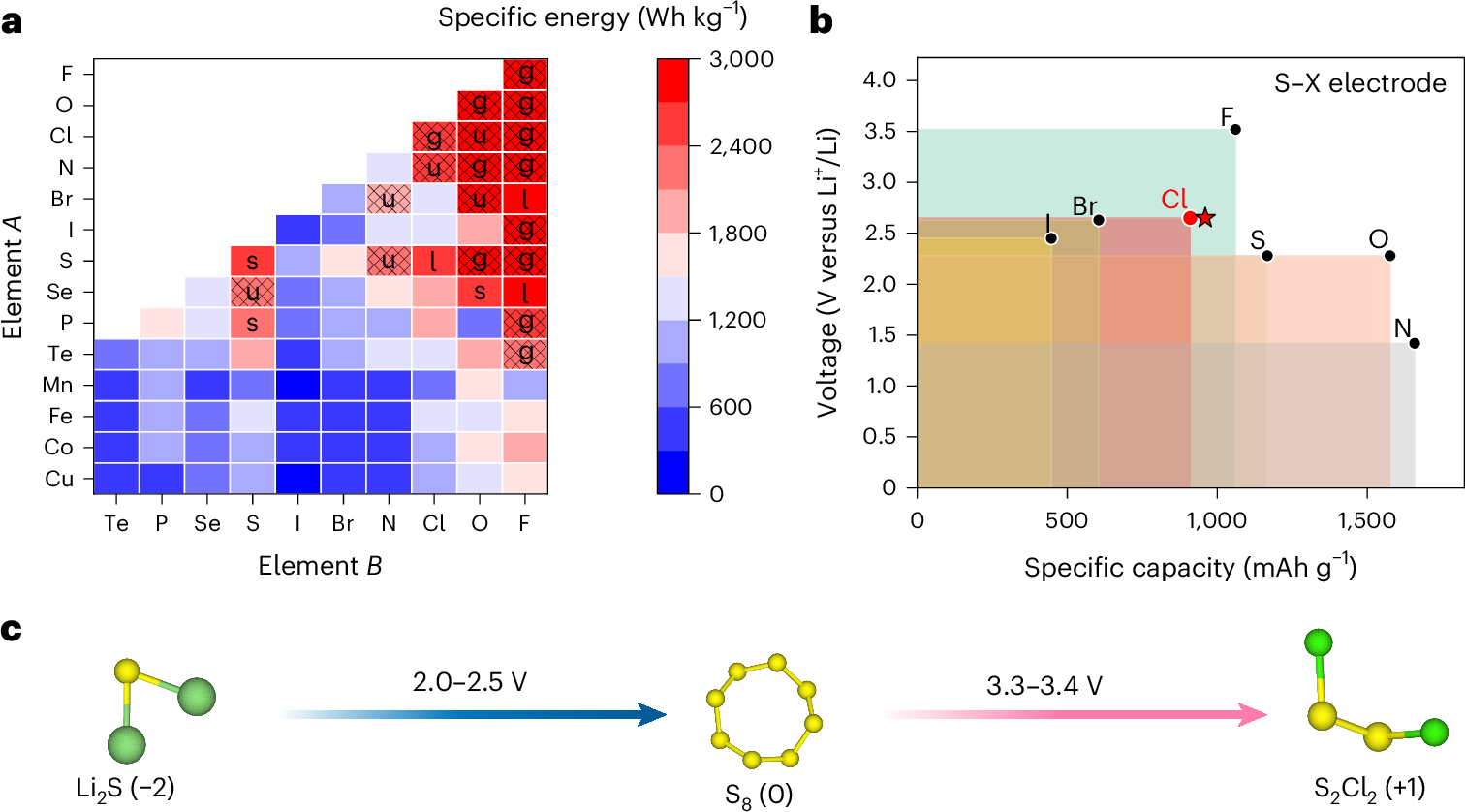
The original Figure 1 above contains different kinds of information. Panels a and b compare theoretical energy and sulfur compounds; panel c illustrates reaction pathways. The colors or star symbols are not certifications of commercial-battery performance.[1]
“Lithium–disulfur dichloride batteries,” published in Nature Energy on September 10, 2026, concerns lithium batteries using S₂Cl₂, a compound of sulfur and chlorine. There is no need to memorize the name first. Follow the question of expanding the reaction range to improve voltage and capacity together.[1][2]
Research stage: laboratory battery research, not a manufactured product or electric-vehicle road test. This explanation uses public research information and institutional accounts; the complete experimental conditions in the main paper and supplementary materials were not cross-checked.
#2. Why this problem is difficult
#A battery does not accumulate little pellets of electricity
Charging is not pouring electricity into an empty box. External energy changes the chemical state of the battery materials; reversing the corresponding change during use supplies electricity. Some stored energy is lost as heat or through other processes. A new reaction does not create energy from nothing.[3]
Distinguish the reaction sites from the particles that move. An electrode is where charge-exchange reactions occur. Electrons travel through the external wiring. Ions are charged atoms or molecules that move internally through the electrolyte, the material enabling ion transport between the electrodes.[3]
During discharge, electrons flow through the external circuit to run a phone or motor, while ion transport maintains internal charge balance. The outer and inner pathways must work together. Good materials alone will not deliver the intended performance if electron flow and internal ion transport do not support one another.
Here, the positive electrode receives electrons from the external circuit during discharge and is where the sulfur reaction is considered. The negative electrode supplies electrons. A short circuit, directly connecting the electrodes without the intended external load, differs from normal operation. The cell must provide the intended external path for electrons and internal path for ions.[3]
#Greater capacity is not the same as greater energy
The mAh commonly seen in battery specifications measures charge capacity. There are 1,000 mAh in 1 Ah. Under simplified conditions, 1 Ah corresponds to supplying 1 A for one hour. The amount actually obtainable depends on current, temperature, and discharge cutoffs.[4]
How much energy that charge delivers depends on voltage, which is related to the energy difference per unit charge between two points. In a water analogy, capacity resembles the amount of water and voltage the height through which it falls. A large amount of water falling through a small height may yield less energy than expected.
Using average voltage, the relationship can be written approximately as follows.
E is energy, the bar over V indicates average operating voltage, and Q is charge capacity. Multiplying volts by ampere-hours gives watt-hours. Two hypothetical 2 Ah batteries with average voltages of 2 V and 3 V would store approximately 4 Wh and 6 Wh. The capacity numbers match, but the energies differ. These are teaching examples, not this paper’s measurements.
Voltage changes during a real discharge. More precisely, energy adds the contribution of voltage over each increment of extracted charge. On a voltage–capacity graph, energy corresponds to the area under the curve. Briefly reaching a high voltage differs from maintaining a higher voltage through much of the discharge.
#Sulfur’s advantages alone are not enough
Lithium–sulfur batteries use sulfur reactions to store charge. Sulfur’s abundance and low cost are advantages, but conventional approaches face low operating voltage and movement of reaction intermediates. Adding more promising material alone does not resolve those problems.[2]
The question is now straightforward: can sulfur exchange more charge and deliver it at a higher average voltage, while repeatedly returning through charge and discharge?

#3. What was missing from the previous approach
#Sulfur becomes different compounds during cycling
A chemical formula is a compact account of composition. S denotes sulfur, Li lithium, and Cl chlorine. Subscripts indicate atom counts. Li₂S, lithium sulfide, has two lithium atoms for each sulfur atom. S₂Cl₂ is a different compound containing two sulfur and two chlorine atoms. Changing the placement of the numbers changes what the formula means.
Conventional lithium–sulfur chemistry uses changes between elemental sulfur and lithium sulfide. Elemental sulfur is often represented as S₈, but electron exchange can be counted per sulfur atom. Do not confuse the eight-atom molecule with the single-atom basis used below.[5]
The conversion is not an instantaneous jump between only two substances. Several sulfur-containing intermediates can form. Polysulfides contain chains of sulfur atoms. If some dissolve in the electrolyte and travel between electrodes, material intended to react at one location can participate in unwanted reactions elsewhere.[2]
This movement is known as the shuttle effect. Think of working material leaving its assigned area and causing losses elsewhere. It can be connected to self-discharge, loss of stored charge even when the battery is not powering a device. Electrons doing useful work through an external load differ from internal reactions consuming stored capacity.[2]
#Improving a route differs from changing its destination
Keeping sulfur-containing material in place and supporting charge transport are important improvements. But these differ from asking which chemical states can be reversibly accessed. It is the difference between making an existing route more efficient and expanding the range of routes available.
This study extends beyond the conventional endpoint of elemental sulfur to a state represented by S₂Cl₂. The accompanying journal commentary highlights access to sulfur’s +1 oxidation state. But what do numbers such as +1 and −2 actually mean?[5]
#4. The new approach in three steps
#Step 1: Expand the electron-exchange range available to sulfur
Oxidation can be understood as losing electrons and reduction as gaining them. Together they form redox chemistry. The word oxidation does not require oxygen to appear in the reaction.
An oxidation state is a formal accounting number assigned by applying rules to bonding electrons. It does not mean an atom in a real molecule necessarily carries that exact isolated charge. Nor does it change the element: sulfur remains sulfur in each oxidation state.[6]
Only three calculations are needed here. Elemental sulfur has oxidation state 0. In Li₂S, assigning +1 to each lithium gives −2 for sulfur. In neutral S₂Cl₂, each chlorine is assigned −1, so the two sulfur atoms together sum to +2, or +1 per sulfur atom.
| Sulfur-containing state | Oxidation state per sulfur atom | What it represents |
|---|---|---|
| Lithium sulfide, Li₂S | −2 | The reduced endpoint of both comparisons |
| Elemental sulfur | 0 | The other endpoint of conventional lithium–sulfur chemistry |
| Sulfur–chlorine compound, S₂Cl₂ | +1 | The higher state used in this study |
The conventional difference between 0 and −2 is 2. The expanded difference between +1 and −2 is 3. Hence the description expanding a two-electron reaction to a three-electron reaction per sulfur atom. Three new electrons are not being created. Charging prepares a wider chemical change, and discharge uses the reverse change.
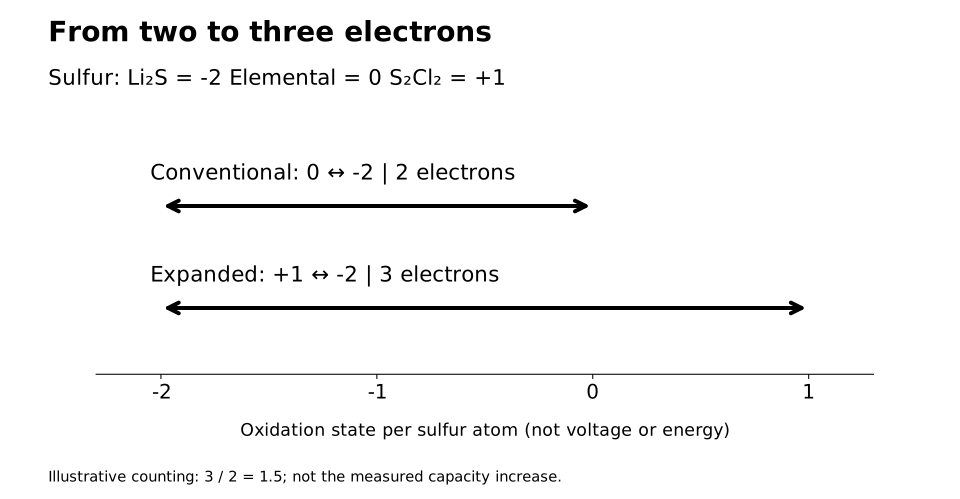
Oxidation-state accounting does not prove that such a battery will work. A transaction permitted on a ledger does not necessarily happen in practice. Experiments must establish formation of the new state, avoidance of unwanted pathways, and reversibility.
#Step 2: Create an electrolyte environment that enables the reaction
The proposed environment is an ionic-liquid electrolyte rich in chloride ions available to participate in the chemistry. Chloride, Cl⁻, is a negatively charged ion. It is not the same notation as chlorine gas, Cl₂, and this is not a proposal to fill a battery with ordinary salt water.[1]
An ionic liquid is a salt composed of ions that is liquid at the relevant operating temperature. Electrolyte does not simply mean “water inside the battery.” Its composition and ionic environment influence possible reactions and stability.[7]
Here, the electrolyte does more than transport ions. It provides an environment that permits sulfur to reach a chlorine-containing state. Its mediating role resembles changing which destinations a delivery system can reach, rather than merely moving parcels along the same route. Specific molecular arrangements and reaction steps still require comparison with the paper’s experiments and calculations.
If chloride-containing components participate in the chemistry, their mass cannot be treated as free. The advantage of using more electrons per sulfur atom must be considered together with what additional materials the complete system requires.
#Step 3: Retain the products and demonstrate the return reaction
Producing a new compound once does not make a rechargeable battery. Reversibility means the reaction can return during charging and discharging. If material escapes or becomes an irreversible product, a strong first result may not persist.
The University of Maryland account says the approach stabilizes the higher oxidation state and keeps products near the positive electrode, improving voltage and capacity while reducing shuttling and self-discharge. This is the research team’s account of its results, not an independent replication report.[2]
The idea therefore involves more than counting one extra electron. It needs a wider reaction range, an environment that enables it, and control that permits repeated conversion without losing material.
#5. Key experiments and numbers
The public paper information reports the following representative values. They are research results, not a specification sheet for a complete product. In particular, the average-voltage comparison is stated for 25°C and 0.2C.[1]
| Metric | Reported value | Appropriate interpretation |
|---|---|---|
| Average operating voltage | 2.05 V → 2.54 V | Improvement under the stated comparison conditions |
| Sulfur-mass-specific capacity | 58% increase | Not capacity normalized by total battery mass |
| Electrode-level specific energy | Above 1,700 Wh/kg | Not a complete-cell or pack value |
| Repeated operation | More than 100 cycles | End-of-life criteria and retained capacity require separate checks |
#The C in 0.2C is not a temperature
The C in 25°C denotes Celsius, whereas 0.2C is a C-rate: current relative to a reference capacity. For a hypothetical 1 Ah cell, 0.2C corresponds to 0.2 A, a current that would ideally take five hours to transfer the reference charge.[4]
That does not establish a five-hour charge time in this experiment. One must check which capacity defines the rate, the voltage limits, and the charging procedure. Results measured at different temperatures or currents cannot be ranked by their headline numbers alone.
#Why the theoretical increase is 50% but the reported value is 58%
For the same number of sulfur atoms, increasing electron exchange from two to three gives a ratio of 3/2 = 1.5. The theoretical increase in available charge is 50%, based on the oxidation-state range. The reported 58% is an experimental comparison and is not the same kind of number.
How much of the theoretical reaction is utilized, along with comparison conditions, can influence an experiment. However, the public information reviewed here does not identify the cause of the eight-percentage-point difference. It is therefore inappropriate to attribute the entire 58% exclusively to electron counting.
#The crucial part of 1,700 Wh/kg is the kilogram
Specific energy divides stored energy by a defined mass. It is also called gravimetric energy density. It differs from volumetric energy density in Wh/L.[4]
Imagine a device storing 100 Wh. If only 0.1 kg of material is included, the result is 1,000 Wh/kg. Including casing and other parts brings the mass to 0.5 kg, giving 200 Wh/kg. The stored energy did not change; the boundary of what was weighed changed. These are hypothetical values, not a reconstruction of this study’s mass balance.
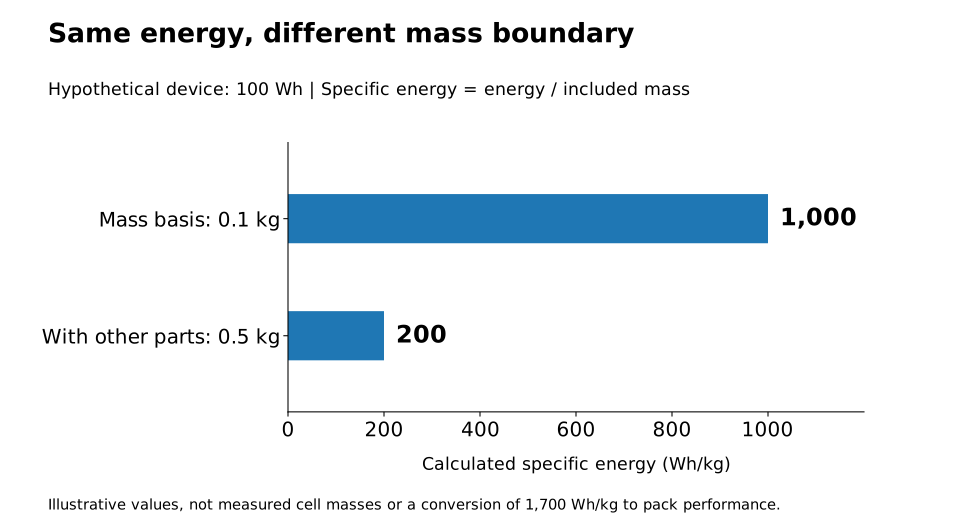
The active material performs the storage reaction. An electrode can also contain ingredients for conductivity and mechanical integrity. A complete cell needs the other electrode, electrolyte, separator, and packaging, while a pack adds connections, management, and protection. An electrode-level result therefore cannot directly predict vehicle range.
This article did not establish exactly which electrode components and participating materials were included in the denominator of 1,700 Wh/kg. What can be stated clearly is that it is an electrode-level report, not a pack-level validation.
#6. Limitations and counterevidence
#Sustained performance under comparable conditions matters more than a peak
Operating for more than 100 cycles supports the repeatability of a new reaction. But capacity remaining at cycle 100, changes in voltage, and variation across cells are different questions. Cycle count alone cannot establish service life or reliability.[4]
Charge efficiency also differs from energy efficiency. If charging requires a higher voltage than discharging delivers, returning the same amount of charge can still involve energy loss. High discharge energy and high round-trip efficiency are related but different metrics.
Sulfur loading usually means sulfur mass per electrode area. Higher loading is one consideration in practical relevance, but a thicker electrode must still react effectively throughout its interior. Favorable operation with a very small amount of material does not automatically carry over to larger amounts.
Lean-electrolyte conditions reduce electrolyte relative to sulfur loading. More electrolyte adds mass, while less may challenge ion transport or the reaction. Since chloride-containing components matter to this chemistry, performance and material input must be evaluated together.
#Safety and manufacturability need their own evidence
Improved voltage and capacity do not replace tests for impact, overcharge, leakage, or high temperature. “Ionic liquid” does not automatically mean nontoxic or nonflammable. Specific composition, interactions between materials, packaging, and protective systems need assessment.
The reviewed public sources do not establish large-cell yield, manufacturing cost, performance after prolonged storage, or total-mass-specific energy under practical conditions. This is the verification boundary of this article, not an allegation that the paper performed none of those tests. We also did not obtain an independent refutation, so lack of verification must not be presented as counterproof.
#7. What could actually change
The scientific interest is that even a familiar element can be used over a redesigned range of chemical states. Rather than simply adding material or improving a surface, this approach broadens the storage reaction itself. It also illustrates why electrode and electrolyte should be considered as a pair.[5]
If the principle survives larger cells and demanding operating conditions, it could contribute to storage for mobile applications where mass matters. Possibility is different from adoption in a named product. A release date or vehicle deployment plan was not verified.
No battery is automatically best for every application. Portable devices may emphasize mass and volume, while repeatedly cycled installations may place more weight on life and cost. Rather than declaring one winner from a maximum energy number, ask under which conditions the advantage survives.
#8. What to watch next
In the next dataset, first ask what was weighed, at which current and temperature it was measured, and how long the performance lasted. Then check whether high sulfur loading and lean electrolyte were achieved together and whether multiple cells and independent teams reproduce the results.
With full access to the main paper and supplements, priorities include the exact electrode-level mass expression, the control behind the 58% increase, and retained capacity over cycling. Reaction-identification evidence and actual data availability also need checking. This article does not fill those gaps as though they had already been validated.
The lasting lesson is this: a useful battery must do more than exchange a large amount of charge. It must do so at sufficient voltage, bear the mass of the required components, and repeat the task many times. Three-electron sulfur chemistry is a research direction seeking to improve those conditions together.
#9. Sources
[1] Nan Zhang et al. Lithium–disulfur dichloride batteries. Nature Energy, September 10, 2026. DOI: 10.1038/s41560-026-02120-8. The public abstract and original Figure 1 and caption were obtained and checked. Access to the complete main text and supplements failed, so no complete raw-data reanalysis was performed.
[2] University of Maryland, Maryland Energy Innovation Institute. University of Maryland Researchers Develop Three Materials Strategies for Higher-Energy Lithium Batteries, September 10, 2026. Only the lithium–sulfur section among the three studies was used. This is the institution’s account of its own research.
[3] U.S. Department of Energy. DOE Explains…Batteries. Background on electrons, ions, and chemical energy storage. Accessed September 12, 2026.
[4] MIT Electric Vehicle Team. A Guide to Understanding Battery Specifications, December 2008, three pages. Used only for definitions of units, capacity, C-rate, and specific energy, not to benchmark current commercial products.
[5] Marco Ricci, Tao Wang, and Remo Proietti Zaccaria. Halogen-assisted sulfur oxidation, Nature Energy News & Views, September 10, 2026. Only the public summary and reaction-concept figure were checked. This is not an independent replication study.
[6] IUPAC Gold Book. Oxidation state, O04365. The formal definition was obtained from IUPAC’s indexed search description; direct access to the individual page failed during that review.
[7] P. Sippel et al. Importance of glassy fragility for energy applications of ionic liquids. Scientific Reports 5, 13922 (2015), DOI: 10.1038/srep13922. The abstract and publication link of the authors’ manuscript, arXiv:1502.06851, were checked. Used only to explain ionic liquids, not as evidence for the 2026 battery’s performance.