Start with the practical answer. Finding a DNA difference associated with disease does not immediately reveal which gene it affects or how. MCCv separates chromatin contacts from the two alleles within the same cell population, narrowing the connection between a small sequence change and regulation at a distant gene. It does not simply nominate the nearest gene as the cause.[1]
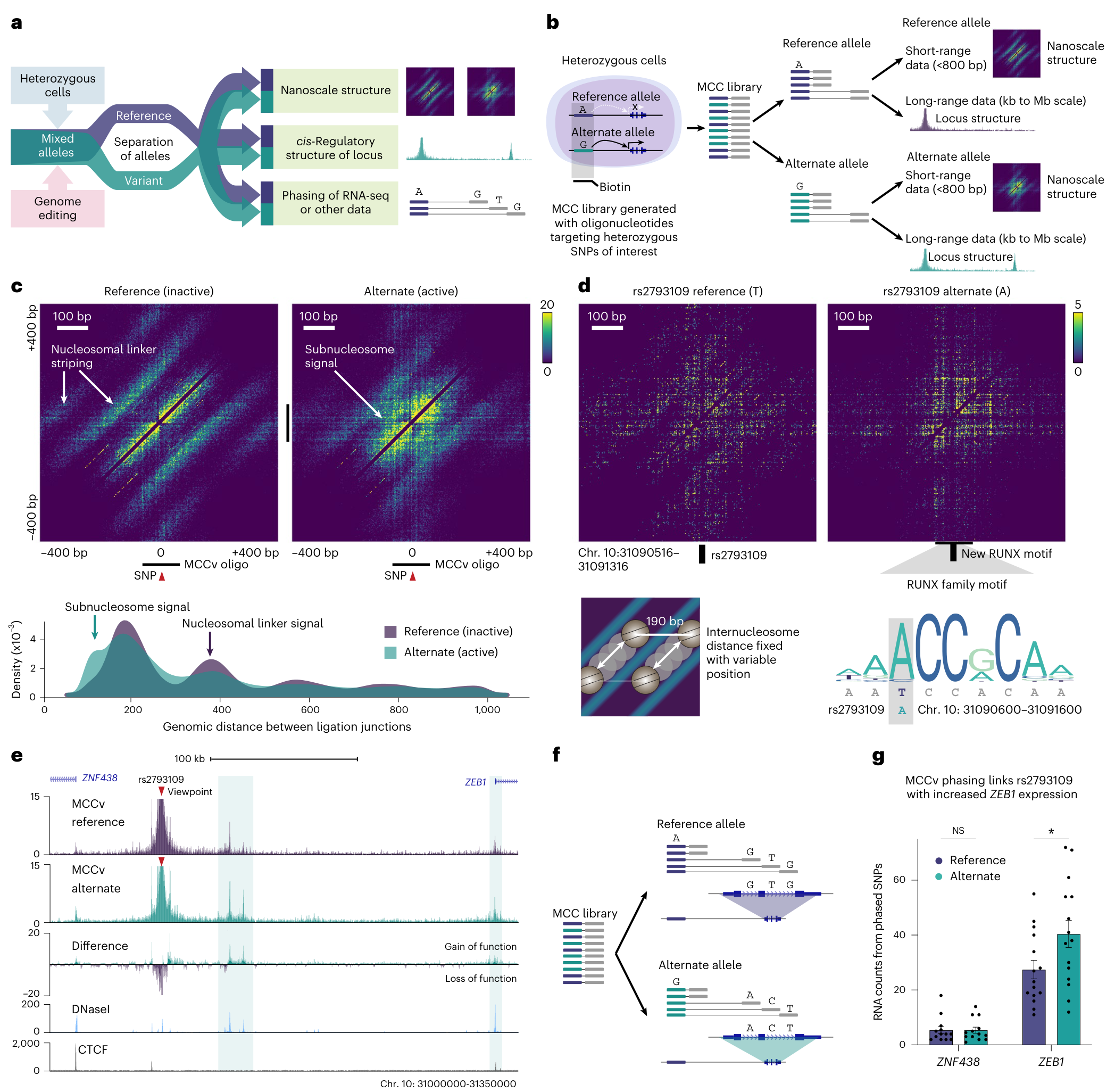
#Reading original Figure 1: local structure and distant connections
Panels a and b show how the two sequences at a locus are distinguished to obtain short-range structural maps and long-range regulatory connections. The heatmaps in c and d are not microscopy images of cells: they summarize contacts between genomic coordinates. Panel e examines distant interactions, f explains phasing of other variants, and g uses this phasing to compare gene expression. The example distinguishes ZEB1 from ZNF438, showing why contact and altered expression need separate assessment.[1]
Start here Variants, enhancers and alleles from first principles Open the explanation
A variant is a sequence difference at a DNA position between people or chromosome copies. An allele is one of those alternative forms. A person with two different forms at the position is heterozygous. The experiment needs to distinguish them to compare the two copies within a common cell population.
Sequences outside protein-coding regions can control gene activity. An enhancer is one kind of regulatory element; a promoter controls transcription initiation. Regions far apart along a linear DNA sequence can become close together in a folded nucleus. However, proximity alone does not prove that an enhancer changes expression at a particular moment. Contacts, transcription and biological function need to be connected through further evidence.[1]
A genome-wide association study, or GWAS, identifies variants that statistically occur with a trait or disease. Nearby variants inherited together can produce a linked signal, so one association is not automatically one causal variant and one causal gene. The gap between association and function is the problem MCCv addresses.
#1. Why the nearest gene can be the wrong answer
A noncoding variant can change a transcription-factor binding site or regulatory architecture without changing a protein sequence. The effect may appear at a distant gene and depend on the cell type or activation state. This is why an observation in one blood-cell population cannot be generalized to the function of every tissue.[1]
Chromosome conformation capture, the 3C family of approaches, uses sequencing to identify interacting DNA regions. Conventional restriction-enzyme approaches are constrained by the positions of cut sites. MCCv builds on Micro Capture-C to generate dense data around a variant, repurposing short-range contacts below 800 base pairs that conventional analyses often discard. It also measures longer-range interactions, linking a local change to candidate regulatory targets.[1][2]
Base-pair resolution describes fine discrimination along DNA sequence coordinates. It does not mean that the entire structure of each individual cell has been completely reconstructed. Single-allele and single-cell are not equivalent terms. Data from a cell population are separated by allele; remembering this prevents overinterpretation of the structural heatmaps.
#2. Three information types combined in one platform
First, short-range contacts reveal local differences around nucleosomes and transcription-factor sites. Second, long-range contacts from the same viewpoint identify links to distant enhancers and promoters. Third, phasing connects nearby heterozygous variants to the same chromosome copy, making RNA data interpretable by allele. Together, these support a sequence of questions: the DNA differs; does contact structure differ; and does expression differ as well?[1]
For example, at rs2793109 in Figure 1, the authors examine contacts involving two candidate promoters and then use phased RNA reads to identify an expression difference for ZEB1. They do not assume that two nearby genes have identical functional changes. An individual example demonstrates the platform’s explanatory power, not a guarantee for every untested variant.[1]
Do contact counts of 60 versus 40 imply 60% disease risk? Expand symbols and the worked calculation
Comparing two alleles in the same population reduces differences in experimental environment, but does not eliminate every bias. Their sequence differences can affect alignment to a reference genome. The paper uses allele-specific analysis with procedures to mitigate mapping bias and with replication. Consequently, the relevant question is not merely whether the maps have high resolution, but how comparison groups and technical noise are handled.
#3. The numbers 405, 241 and 251 have different denominators
The supplied editorial selection described 405 investigated regulatory variants. The paper’s abstract and results distinguish 405 cis-regulatory elements from the 241 heterozygous sites across three donors that yielded phased allele-specific tracks. It also nominates 251 candidate causal genes from contact information. None of this should be rewritten as causal validation of every one of 405 variants.[1]
| Number | What was counted | What it does not mean |
|---|---|---|
| 405 | Investigated regulatory elements associated with immune disease | 405 clinically established therapeutic targets |
| 241 and three donors | Heterozygous sites enabling phased comparison across the donors | Every target was identically testable in every person |
| 54.6% | Heterozygous disease-associated variants with at least one significantly altered contact | 54.6% of patients develop the disease |
| 251 | Candidate causal genes nominated using contact data | Every gene completed editing, expression and disease validation |
The authors explicitly note that enhancer–promoter contact does not always cause a transcriptional change. Contact mapping is particularly useful for eliminating unlikely candidates and prioritizing further validation. Enrichment of allelic expression imbalance among genes linked to contact-altering variants supports the approach, but formal functional validation at the variant or gene level is still needed.[1]
Using the same label for a candidate cause and a confirmed cause can make the path to a drug look artificially short. MCCv does not remove that path in one step; it narrows it through more direct measurements. Because the disease analysis prioritizes CD4-positive T cells and selected immune-disease loci, applying the platform to other tissues or diseases requires reconsidering target selection and context.
#4. The SESN3 example: gaining a binding site can block another connection
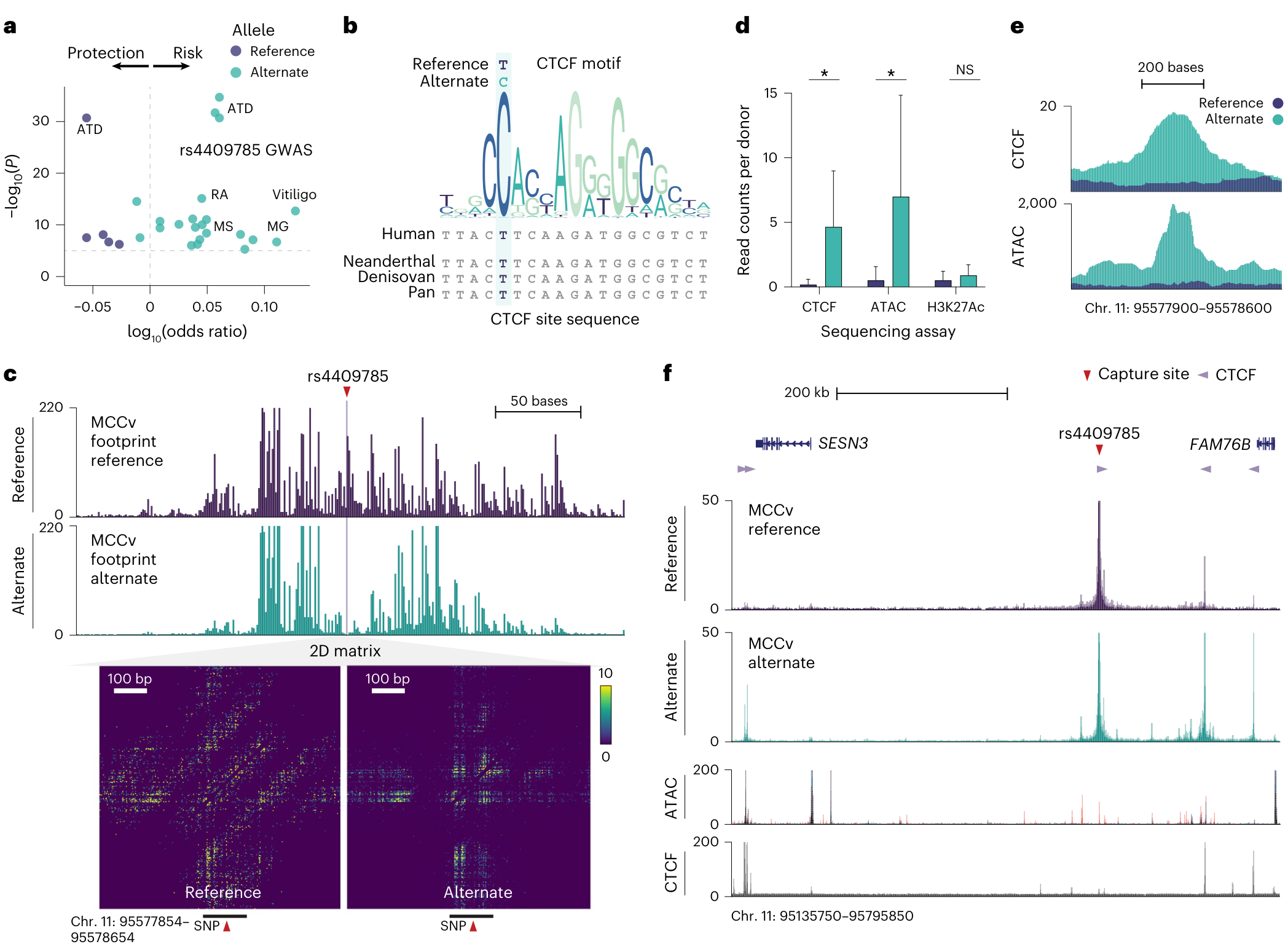
#Reading original Figure 4: the variant does not create a new protein
This figure examines the risk allele of rs4409785, which creates a CTCF-binding motif. Panel a shows disease associations; b the sequence motif; c local contact architecture; d and e CTCF binding and chromatin accessibility; and f longer-range contacts. A larger contact peak on the risk allele does not mean that every gene is more highly expressed. A new structural boundary can reduce another important regulatory interaction.[1]
The paper connects the neo-CTCF site with strong contacts to downstream CTCF sites and with reduced contact between the SESN3 promoter and a T-cell enhancer region. CTCF is not merely a transcriptional on-switch: it participates in structural connections and boundaries. A gain of binding-site function can therefore be associated with reduced regulation elsewhere. That apparently counterintuitive connection is central to this example.[1]
Additional genome-editing experiments alter the functional CTCF motif while retaining the variant that distinguishes the alleles, and compare the result with control editing. Original Figure 5 separates the two alleles and several editing outcomes to inspect changes in contact architecture. This provides stronger mechanistic evidence than association alone, but remains an individual validation—not the same editing experiment repeated for all 405 targets.[1]
#5. From contacts to cellular function and an animal phenotype
The authors investigate SESN3 in the connection between nutrient sensing and mTOR signaling. In a T-cell context, they examine free tryptophan, interaction between SESN3 and GATOR2, and signaling under nutrient deprivation. These conditional molecular observations narrow the mechanism. They do not establish identical behavior in every tissue, nor show that consuming tryptophan treats autoimmune disease.[1]
Animal validation perturbs Sesn3 in hematopoietic stem and progenitor cells and observes accelerated disease progression in an experimental autoimmune encephalomyelitis (EAE) model. A human noncoding risk variant, editing of a specific regulatory motif, and gene disruption in mice operate at different biological levels. Agreement across them strengthens the interpretation, but is not equivalent to repeating the same intervention in the same species. EAE is not a human treatment-efficacy trial.[1]
A useful reading sequence is association → architecture → expression → molecular function → disease phenotype. At each arrow, ask what was directly measured and what remains an interpretation. Connecting a long pathway is not the same claim as definitively settling every link. This framework also helps assess other functional-genomics studies.
#6. Reproduction resources and competing interests
The paper provides sequencing-data accessions at GEO, processed nanoscale maps through Zenodo, and Source Data. Its software is not all offered under one unrestricted license. The MCC pipeline, peak caller and variant-to-function analysis are made available for academic use through Oxford University Innovation, while SNP-prioritization code and basepairC have separate GitHub locations. Readers need to check conditions for their intended use; this explainer grants no additional software rights.[1]
Update to the supplied selection. The draft left commercial interests unverified. The original paper discloses co-founder, consultancy and director roles at Nucleome Therapeutics for some authors, alongside an MCC-method patent licensed to that company. It also discloses technology licensing and shareholding involving BEAM Therapeutics, a Dark Blue Therapeutics consultancy, and an Illumina employment explanation. These disclosures must not be omitted and replaced with “no competing interests.” The other authors declare no competing interests.[1]
Disclosed interests do not automatically invalidate the measurements; they inform how independent replication and access conditions should be assessed. The presence of links, academic-use terms for some software, and independent reproduction of the full analysis are three different facts. This blog update checked the article and relevant supplementary explanations, but did not realign sequencing reads or refit the statistical models.
#7. What to watch next
Follow-up work should establish which variant–target connections persist across donors, activation states and cell types. Allele-specific comparisons that are possible at some loci may be impossible at others; rare variants and low read depth create additional constraints. Reporting failed or inconclusive targets, not just successful analyses, would clarify the platform’s practical range.
High-priority candidates next need additional editing, expression and functional validation. Interventions also need to be tested for intended cellular effects and unintended consequences elsewhere. Clinical efficacy and safety remain later, distinct questions. The supplied editorial score of 97 is not a calibrated probability of medical utility.
MCCv’s value is not that it automatically prints the final answer for every disease-associated DNA letter. It combines previously discarded short-range information with longer-range contacts, separated by allele, to formulate narrower and more direct questions for validation. Its contribution is clearest when high spatial resolution is not confused with unlimited causal certainty.
#Sources and verification scope
[1] Hamley et al., Single-allele nanoscale mapping of regulatory variants, Nature Genetics, Version of Record published 2 October 2026, DOI 10.1038/s41588-026-02776-8. Results, Discussion, Data/Code availability, competing interests and Figures 1 and 4 checked on 5 October 2026. Publisher article.
[2] Supplementary Information to the same paper, including target selection, phasing, analysis explanations and conditions for extending capture scale. Supplement.
This article follows the supplied candidate selection and questions. The definition of the 405 targets and previously unverified interests are explicitly updated from the primary paper. It does not reclassify an individual’s variants clinically or recommend a drug or dietary intervention. No complete source-data reanalysis or experimental replication was performed. Both original figures retain all panels, axes, annotations and colors, with attribution under CC BY 4.0. This article does not display advertising.