Research stage: laboratory work on electrolyte films and pouch cells, not electric-vehicle battery manufacturing or vehicle road tests. On September 12, we obtained the publisher’s early-release PDF and checked Figures 2 and 5, their captions, and the associated test conditions. We did not reanalyze all supplementary or raw data. The original images retain their noncommercial, no-derivatives licensing conditions.
#1. The conclusion in one sentence
A solid-state battery is not completed by finding a promising material. That material must become a thin, usable film through which ions can move effectively. A study published in Nature Communications on September 10 addresses this manufacturing problem.[1]
#2. Why this problem is difficult
Charging does not simply pour electricity into a small box. It changes a battery’s chemical state to store energy; during use, the corresponding change supplies electricity. Electrons travel through the external circuit, while charged particles called ions move internally through the electrolyte.[2]
The electrolyte is the pathway for ions. Solid-state batteries seek to implement that pathway using solid materials. “Solid” does not mean the ions cannot move. This study concerns a sulfur-containing sulfide solid electrolyte and a process for making it into an independent film.[1]
A thinner pathway can shorten the distance traveled, but a real film must also control gaps and cracks. A thinner wall does not automatically make a better house. Thickness and uniformity must be considered together.
#Distinguishing electricity from energy makes battery news easier
Thinking of a battery only as a tank of electricity can be misleading. Charging uses external energy to change the materials’ chemical state; discharging supplies electricity through a change in that state. Charge motion inside and outside the battery is coupled, but electron movement through the electrolyte is not the same description as ion transport.[2]
An ion is a charged atom or molecule. An electrode participates in electrochemical reactions and charge exchange, while the electrolyte carries ions internally. A solid electrolyte does not flow as a liquid does, but that does not mean all its ions are immobile. This distinction is the starting point of the article.[2]
Even the analogy “a shorter path is faster” needs care. A short pathway may perform poorly if it is obstructed or makes poor contact with another component. A thin film can offer one advantage, but material properties and contact quality still matter. Battery research cannot be reduced to a competition over one number.
#Cells, modules, and packs are different levels of assembly
A cell is a single electrochemical unit assembled from electrodes, electrolyte, and other parts. Modules and packs combine and connect cells; complete products also require thermal management and monitoring. The pouch-cell test discussed here is not validation of a vehicle battery pack. Packaging format alone establishes neither capacity nor application.
Units also serve different purposes. Micrometers describe lengths such as film thickness. Milliampere-hours measure charge capacity, while watt-hours measure energy. Two cells with equal charge capacity do not necessarily store equal energy because voltage matters, too. Recording both the unit and the component being measured helps prevent confusion.
#3. What was missing from the previous approach
Separate material performance from component performance. A material may conduct ions well, but retaining that property after film fabrication is a separate question. Even a good film must be evaluated again after it is assembled with electrodes into a complete cell.
A freestanding film can be handled after removal from its support, rather than maintaining its form only as an attached coating. This matters when moving and stacking components during manufacturing. The publisher identifies the difficulty of producing thin, highly conductive sulfide films as the study’s starting point.[1]
#“A good material” can hide several different tests
Material evaluation asks how readily ions move through a substance. Manufacturing evaluation asks whether it can be made thin and uniform. Assembly evaluation asks whether it contacts the electrodes well and continues functioning through repeated cycling. Success at one stage supports proceeding to the next, but does not substitute for success there.
Finding good flour, making thin noodles, and cooking them without breaking are different tasks. The analogy distinguishes how raw materials and finished products are evaluated. In this study, “how can it be processed into a usable film?” is a better starting question than simply “what new material was discovered?”
Freestanding means the film can retain its form and be handled after separation from a support. The word does not simultaneously guarantee defect-free large areas, high production speed, and low cost. Being able to hold a sheet of paper is different from producing uniform sheets at scale. Further manufacturing evidence is needed.[1]
#4. The new approach in three steps
First, the researchers focused on fabricating thin, freestanding sulfide-electrolyte films. This differs from a study concerned only with a new electrode material.[1]
Second, they proposed a quasi-dry process assisted by the additive α-pinene. Quasi-dry names a manufacturing method; it does not mean the battery is “only half solid.” The paper describes contributions to PTFE distribution, stress dispersion, and densification. That is the authors’ mechanistic interpretation, not independent replication of the mechanism.[1]
Third, they reported repeated cycling in pouch cells as well as film properties. “Pouch” describes packaging and does not itself guarantee high capacity or automotive suitability.[1]
#A process name is not a complete mechanism
The publisher’s account identifies α-pinene-assisted quasi-dry fabrication, but the name alone cannot establish which molecules the additive interacts with, the binder structure it produces, or its amount. A chemical’s role depends on its purpose and conditions. This article separates the roles described in the paper from independent confirmation and does not claim every quantitative supplementary comparison was verified.[1]
“Quasi-dry” can also be confused with the final material’s state. Here it classifies the process. Asking whether an all-solid-state battery is partly liquid because its process is quasi-dry mixes manufacturing conditions with cell structure. Exact liquid usage and removal conditions require the original methods.
To interpret a comparison, check what remained unchanged besides the presence of the new additive. Changes in film thickness, electrode loading, pressure, or temperature can alter the interpretation. These are questions for reading the source, not an accusation that the researchers failed to use appropriate controls.
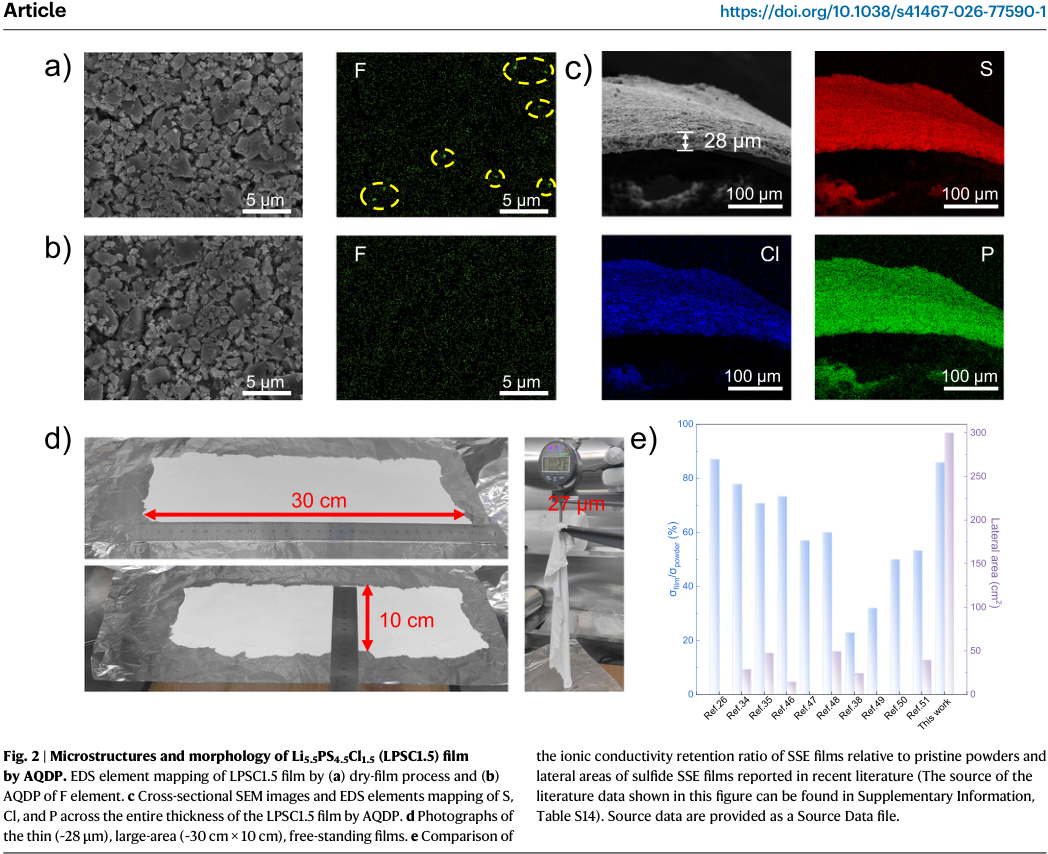
Photographs and numbers serve different purposes in process research. A film photograph illustrates handling; a cross-section can show thickness and structure. Conductivity measurements and cycling tests assess function. An attractive photograph cannot replace all of those measurements, so its evidential role should be stated in the caption.
#5. Key experiments and numbers
The publisher reports 83% capacity retention after 1,000 cycles. With the reference capacity in that test normalized to 100, the final measured capacity is 83. It does not mean the cell can only charge to an 83% state of charge or has 83% energy efficiency.[1]
Comparison with other studies requires temperature, rate, external pressure, reference capacity, and the number of replicate cells. Figure 5d identifies a pouch cell with an LTO negative electrode and NCM93 positive electrode, tested at 40°C, 0.5C, and 2 MPa. This result is not converted here into electric-vehicle service life.
The importance of thickness can be explained with a basic relationship for a uniform film. It is a simplified model, not a new equation introduced by the paper or a measurement of the entire cell.
R is resistance to ion transport, L is thickness, σ is ionic conductivity, and A is the transport area. With material and area unchanged, halving thickness halves the film’s bulk resistance. A real battery has additional contributions, including contact resistance at the electrodes.
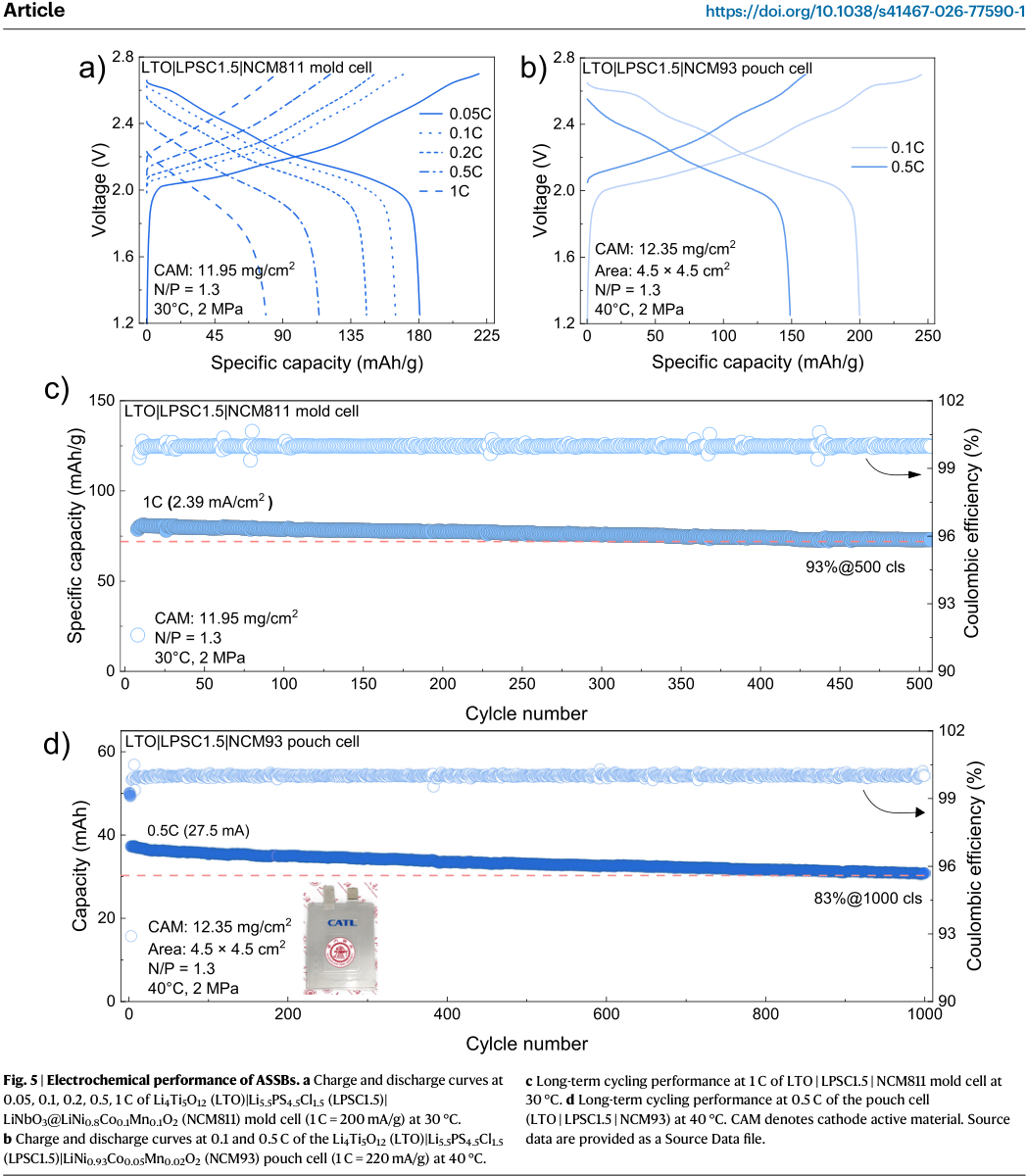
Figure 2d shows an approximately 30 × 10 cm film alongside a thickness measurement, and Figure 2c labels a cross-section approximately 28 μm thick. Figure 5’s right-hand coulombic-efficiency axis and left-hand capacity axis represent different metrics. In particular, the 83% in panel d is capacity retention, not efficiency.[1]
#Read the equation in ordinary language
Thickness corresponds to the path’s length, area to the space available for transport, and conductivity to how readily the material permits that transport. A longer path increases resistance; larger area or conductivity lowers it when other factors remain the same. A solid electrolyte is not literally an empty pipe: this analogy only explains the proportional relationship.
For illustration, compare uniform 40 μm and 20 μm films with identical material and area. The thinner film has half the bulk resistance. These are hypothetical numbers, not the thickness measurements reported in this study. Poorer electrode contact or internal defects could change the complete cell’s result. Halving film resistance does not mean charging time is exactly halved.
When comparing samples of different area, multiplying both sides by area helps separate that geometrical contribution.
Units must remain consistent. Mixing centimeters and conductivity in siemens per centimeter with quantities expressed in meters gives an incorrect calculation. Check the units before copying numbers. Again, the relationship is a uniform-film model, not a replacement for experimental data.
#What is divided to obtain capacity retention?
For “83% after 1,000 cycles,” first identify the reference capacity: which initial cycle was used, and whether measurements used comparable conditions. Normalizing that reference to 100 makes the final value 83. It does not imply losing 17% of charging energy on every cycle or an 83%-efficient charger.[1]
A cycle counts repeated charging and discharging, but the extent of each charge and discharge also matters. C-rate expresses current relative to a reference capacity. Equal cycle counts can represent different stresses if current, voltage window, temperature, or rest periods differ. This article gives the conditions verified in the source and does not build a simplistic ranking against experiments performed under other conditions.
#6. Limitations and counterevidence
One strong cycling result does not resolve every manufacturing problem. Thickness variation across repeated films, large-area defects, and larger-cell assembly remain important. These are evaluation criteria, not claims that the paper failed to test those issues.
Cycling life and fire safety are also different. Long life does not establish safety under impact, overcharge, or short circuit. The paper identifies CATL support and affiliated researchers, while the authors declare no competing interests. Company participation and the formal disclosure should be read as distinct pieces of information.[1]
#Even a good graph leaves questions to ask
A cycling plot requires its axes, legend, and number of cells. The best cell, a representative cell, and a mean over repeated tests provide different evidence. Standard deviations must not be invented, and a maximum must not be called an average without checking the source. This article therefore includes the original complete Figure 5 rather than a fabricated cycling curve.
The final capacity alone cannot reconstruct the trajectory. An endpoint of 83% does not tell us whether loss was rapid initially, gradual, or irregular. Drawing a smooth decline without data could look like a measured result. Here, the original curve is retained and explained together with its axes, legend, and test conditions.
An interface is the boundary between different materials. Properties within the electrolyte film must be distinguished from behavior at its contact with an electrode. This is another reason not to apply the bulk-resistance model to the entire cell. A solid material does not automatically solve every contact problem; assembly conditions matter.
External pressure is another relevant condition. Pressure is not force alone: the same force produces different pressure over different areas. Maintaining a test pressure in a vehicle pack raises additional structural questions. Figure 5’s cycling tests use 2 MPa, and the paper describes poorer high-rate performance at lower pressure. It should therefore not be presented as a pressure-free battery.[1]
Cycling tests also do not replace safety tests. Evaluations under heat, impact, overcharge, or internal short circuit ask different questions from repeated cycling under normal conditions. “All-solid-state” does not justify saying “cannot catch fire.” Conclusions must remain within the conditions and outcomes actually examined.
#7. What could actually change
With further validation, the process could help bridge material development and cell assembly. Industrially, the question becomes not only which chemical works, but how consistently it can be fabricated into useful components. Reduced production cost or successful mass manufacturing has not been established by this review.
#Three bridges from material to manufacturing
The first bridge runs from material to film: does processing preserve ion transport, and can the film be handled reliably? The second runs from film to cell: does it function after assembly with other materials? The third runs from cell to manufacturing: can the required quality be reproduced at the necessary size and speed?
Separating these stages avoids both undervaluing and exaggerating laboratory results. A study that builds the first bridge well need not already complete the third. Conversely, crossing the first does not establish manufacturing cost or yield. A contribution should be evaluated at the stage actually demonstrated.
Manufacturers care about the thickness distribution, not only the minimum thickness. One very thin point is different from an entire large film remaining within specification. Yield is the fraction meeting specified criteria, so the criteria must be known first. This article neither estimates the researchers’ yield nor calculates undisclosed manufacturing costs.
A reader interested in chemistry may ask whether the process transfers to other compositions. A reader interested in manufacturing may focus on variation across repeated production. Both questions matter. The industrial significance lies in connecting a material to a usable form, not solely in the final cycling number.
#8. What to watch next
Beyond the dimensions and Figure 5 conditions checked here, the next step is cross-checking supplementary and raw data. Cell-to-cell variation, replication at larger capacities, fabrication speed, and defect rates follow. Each transition—from good material to good film to good battery—needs its own evidence.
#Which pages should be examined next?
The original PDF, photographs, and cycling curves have now been obtained. Further review should connect supplementary composition information, comparisons isolating the additive’s role, cell configuration, and replication counts to the raw data. Supplementary material can contain conditions needed to interpret the main text; a title and abstract cannot settle a mechanism. Data availability and disclosures also deserve separate checks.
Larger films and cells, repeated demonstrations, production speed, and failure rates become important next. This is a list of evidence to inspect, not an allegation that the current study omitted every test. Deciding in advance which evidence would strengthen which conclusion helps prevent one impressive number from dominating the assessment.
An actual electrolyte film is a more appropriate lead image than an electric car. This article uses the full Figure 2, including the original film and cross-section. Cross-sections require a scale; cycling curves require test conditions. Marking an unresolved point is more informative than hiding it behind an image.
The lesson is not “thinner is always better.” It is that an ion-conducting material must be formed into a uniform, handleable film and then function repeatedly in a real cell. Separating material, component, and finished-product evidence makes the next solid-state-battery announcement easier to judge.
#9. Sources
[1] Lou et al., “Additive-assisted quasi-dry process enabling freestanding sulfide electrolyte films for all-solid-state batteries,” Nature Communications, September 10, 2026. Publisher listing, article. DOI: 10.1038/s41467-026-77590-1. The publisher’s 12-page early-release PDF was obtained on September 12; Figures 2 and 5 and their associated text and captions were checked. Full supplementary-data validation remains incomplete. Images are licensed CC BY-NC-ND 4.0; this does not grant commercial-use permission.
[2] U.S. Department of Energy, DOE Explains…Batteries. Accessed September 12, 2026; used for battery fundamentals only.