Ezekiel 2:1–3:11 · Report 3 of 3
Social science, trauma, and reception
Read the translated research, tables, images, and bibliography below. Scholarly claims and ratings remain the supplied draft’s assessments, rather than independently verified peer-review findings. The Korean Naver original is preserved below for comparison. Hebrew terms are retained; scriptural phrases are translated lexical glosses or identified public-domain WEB excerpts, rather than reproductions of an unverified copyrighted English edition.
World English Bible: Ezekiel 2 · Public-domain notice
3. Ezekiel 2:1–3:11: Social-Scientific Criticism and Exilic Identity — Prophetic Authority, Trauma, and Reception
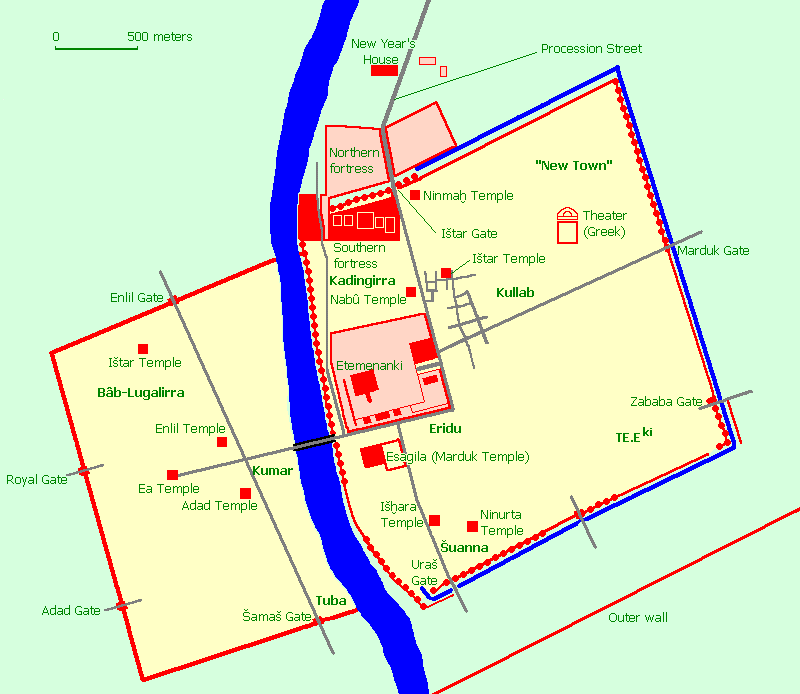
Modern map of Babylon’s major sites and urban layout. It includes a later Greek theater and therefore does not reconstruct a single moment in Ezekiel’s lifetime. Jona Lendering / Livius.org, Wikimedia Commons; unchanged. Image source · CC BY-SA 3.0
A. Exilic social-historical map
The study locates the call in the forced deportation of 597 BCE, when Jehoiachin and Jerusalem’s priestly, scribal, and artisan elites were taken to Babylonia. Groups settled around Tel-abib in the Chebar canal region, part of an artificial irrigation network[1]. Beyond displacement and political subjection, exile removed access to temple and royal court, the material centers of communal authority.
In foreign imperial space, the community faced identity disruption and an authority vacuum[4]. The elders’ role across Chapters 8, 11, 14, 20, and 33 is important. With state institutions disrupted and Davidic and Zadokite power inaccessible, family and tribal elders emerged as limited communal leadership in diaspora[6]. Elders sitting before Ezekiel in Chapters 8 and 14 may acknowledge or test his authority. His charge of inward idolatry (14:3) challenges inherited authority and establishes divine speech as the basis for a new spokesperson.
Letters linking Jerusalem and the exiles, as in Jeremiah 29, and competing promises of rapid return divided the community. For a displaced priest facing identity crisis, the call legitimates YHWH’s messenger and becomes a political-theological narrative of communal survival.
B. Models of prophetic authority
Max Weber’s typology serves as an explanatory analogy for Ezekiel’s multilayered authority. The text presents a hybrid rather than a single traditional model[1].
|
Authority model |
Textual expression and social function |
Weberian analogy and critical perspective |
|---|---|---|
|
1. Charismatic authority |
The Spirit raises him (2:2), and overwhelming sacred visions authorize him. |
Extraordinary authority emerges amid collapse of routine temple order; the call experience becomes a basis for recognition. |
|
2. Priestly authority |
Ezekiel is identified as priest and son of Buzi (1:3). Despite disrupted temple access, purity language and strict boundaries retain priestly patterns of thought. |
A residue of traditional authority: elite status through Torah and ritual memory despite spatial exile[4]. |
|
3. Scribal / textual authority |
The scroll’s reception within the body presents written words as fixed, binding truth. |
An analogy to documentary or legal-rational authority: durable text guarantees sacred authorization[10]. |
|
4. Visionary authority |
Witnesses YHWH’s throne and Merkabah beside the Chebar, outside the temple (Chapter 1). |
Privileged vision of an inaccessible divine realm represents knowledge unavailable to elders or rival prophets[11]. |
|
5. Divine-messenger authority |
The “This is what the Lord GOD says” formula in 2:4 evokes a royal envoy. |
Delegated authority: rejecting the envoy is construed as rebellion against the sending sovereign[12]. |
|
6. Hybrid authority |
Priestly knowledge, scribal text, apocalyptic vision, and the Spirit’s presence converge in one body. |
Amid institutional collapse, inherited priestly resources and new vision / scroll revelation combine to establish leadership and social authority. |
This hybrid is a textual strategy explaining how YHWH’s rule can persist beyond the temple, rather than merely a personal experience report.
C. The rebellious house and social identity
Israel is repeatedly named בית מרי (bêt mĕrî), the rebellious house[13]. Readings associated with Paul M. Joyce treat this as social and rhetorical boundary-making that reconstructs communal identity, beyond moral blame alone[1]. Constructive and critical readings differ sharply on its effect.
A constructive reading sees the diagnosis as theological surgery: a traumatized community viewing itself only as an innocent imperial victim is confronted with its own covenantal responsibility as well as Babylon’s violence[3]. Looking inward for responsibility can restore moral agency and enable repentance through prophetic shock.
A critical reading recognizes stigmatization: predefining hearers as permanent rebels can free the speaker from dialogue and persuasion, reduce them to objects of judgment, restrict imagined repentance, and provide a theological excuse for rejection or failed ministry that shields religious power from criticism[2].
D. Transgenerational memory matrix
Ezekiel 2:3 places present rebellion in continuity with ancestral transgression. This creates a canonical tension with Chapter 18’s individual responsibility.
|
Perspective |
Function of ancestral transgression in Ezekiel 2:3 |
Canonical comparison with Ezekiel 18 |
|---|---|---|
|
Transgenerational guilt |
Locates rebellion in historical continuity and social habitus rather than inherited biological guilt. |
Chapter 18 rejects inherited liability through its sour-grapes proverb[4]. |
|
Covenant history |
Constructs a macro-narrative from exodus to exile, defending the justice of YHWH’s judgment. |
Chapter 18 opens an individual path to life through present covenantal response, within the weight of collective judgment. |
|
Social memory of failure |
Memory of rebellion undermines complacent nationalism and unconditional temple-protection ideology. |
Chapter 18 calls for active repentance beyond ancestral failure: Chapter 2 diagnoses communal soil; Chapter 18 describes an individual’s change of direction. |
|
Prophetic rhetoric |
Comparison with the ancestors challenges spiritual pride and legitimates prophetic criticism. |
This is a call for changed behavior, not an essentialist curse. Using ancestral guilt to condemn Jews or any people perpetually seriously distorts the passage. |
E. Redefining prophetic success
The repeated whether-they-hear-or-refuse formula (2:5, 7; 3:11) fundamentally redefines success in prophetic ministry[14]. In the reading associated with Daniel I. Block, it provides a theological antidote to results-driven leadership[9].
|
Model of prophetic success |
Application in Ezekiel 2:1–3:11 |
Test against the wider book |
|---|---|---|
|
1. Outcome model |
The unit rejects numerical repentance or revival as the success criterion and anticipates organized refusal. |
Judgment’s fulfillment despite rejection, including Jerusalem’s fall announced through Chapter 24, retrospectively establishes the word’s truth. |
|
2. Fidelity model |
Faithful, uncompromised performance of the received text fulfills the ministry[14]. |
Connects with Chapter 33’s watchman: giving warning discharges responsibility, while reception belongs to the audience. |
|
3. Witness model |
The ultimate aim is later recognition that a prophet was among them. |
Joins the book’s recognition formula, in which people come to know YHWH, aiming at acknowledgment after judgment rather than immediate change[16]. |
|
4. Judgment model |
Refusal of the proclaimed word becomes evidence supporting judgment in the heavenly court. |
In 3:17–21, silence makes the prophet accountable, whereas warning leaves the wicked responsible. The word can serve judgment as well as salvation. |
|
5. Mixed model |
Requires fidelity regardless of outcomes while anticipating that severe witness may eventually prepare the restoration of Chapter 37. |
The shift toward consolation after news of Jerusalem’s fall in Chapter 33 places fidelity within a larger horizon of communal renewal. |
F. Prophet–audience power matrix
The opening establishes asymmetry: Ezekiel holds and transmits divine words, while hearers are framed as rebels.
|
Element of power asymmetry |
Textual analysis and social dynamics |
Comparison with Deuteronomy 18: Prophecy validation |
|---|---|---|
|
Who interprets and judges? |
Ezekiel receives exclusive interpretive authority because the text originates in the heavenly court, beyond arbitrary evaluation by elders or hearers. |
Deuteronomy 18:20–22 allows public testing through fulfillment. The study reads Ezekiel 2 as substantially limiting prior audience validation. |
|
The audience’s right to challenge |
Hostile resistance appears through briers, thorns, and scorpions (2:6), but is not recognized as theologically valid objection. |
Opposition is rejected and reframed as further evidence of rebellion[9]. |
|
Validation of prophecy |
Recognition in 2:5 comes after historical catastrophe rather than through prior acceptance or agreement. |
While Deuteronomy 18 stresses fulfillment, this reading emphasizes the rejected prophet’s presence and enacted judgment as confirmation of YHWH’s authority[16]. |
G. Scribal authority, text, and social hierarchy
The scroll of 2:9–10 marks a development in prophetic narrative. Research associated with Nili Shupak and Karel van der Toorn links possession of writing with bureaucratic authority in the ancient Near East[10]. Amid limited literacy, text could carry mysterious power or the binding force of imperial law.
Ezekiel’s priestly and scribal background helps explain revelation experienced as a material scroll rather than only a voice or dream[4]. Five models illuminate it:
Textual Authority: Dense double-sided writing (2:10) symbolizes full, closed revelation that the human messenger may not alter[20].
Archival Authority: Writing preserves evidence across generations, functioning as the heavenly court’s indictment of the rebellious house.
Scribal Identity: The scroll suggests a priest deprived of temple ritual acquiring an identity as keeper and proclaimer of text[22].
Symbolic Totality: Lamentation, mourning, and woe take material and symbolic form in the text itself[12].
Embodied Revelation: Written text moves beyond reading into physical incorporation within the prophet.
H. The embodied text
The hand → mouth → belly movement in 2:9–3:3 invites reading through performative text and material religion[13]. Ezekiel is more than a passive listener memorizing and repeating divine words.
As Ellen F. Davis argues in Swallowing the Scroll, swallowing the material scroll is an ontological transformation: text becomes assimilated into the prophet’s bodily system[24]. The inward body becomes a physical repository of revelation[13]. Private identity and subjective speech yield to a body functioning as sacred sanctuary and medium of YHWH’s text. Honey-like sweetness (3:3) expresses joy in obedient union with divine will despite the scroll’s violent judgment[9]. The body becomes an extreme form of technology for divine memory.
I. Oral–written–performed word model
The passage does not imply a simple linear advance from oral to written culture. Instead, written revelation and oral proclamation interact in a complex circuit.
|
Medium of transmission |
Textual expression and function |
Complex, nonlinear interaction |
|---|---|---|
|
Written scroll |
Visible and material words of lamentation and disaster (2:10). |
Source data guaranteeing revelation’s definiteness, stability, and completeness; a totality of scribal knowledge[24]. |
|
Embodied memory |
Filling the belly and inward parts (3:3): bodily incorporation. |
Text becomes inscribed at a bodily and existential level: a transition from material object to somatic memory. |
|
Oral proclamation |
Command to go and speak God’s words (3:4): audible utterance. |
The stored text becomes public oral performance through the prophet’s mouth[4]. |
|
Hearing and response |
The whether-they-hear-or-refuse formula (2:5): the recipient’s disposition. |
Response does not determine revelation’s validity. Written → embodied → oral → performed completes the multidimensional process. |
Written revelation becomes embodied memory through eating, then returns as oral proclamation: a cyclical system of performance.
J. Accountability: The prophet must also obey
The warning in 2:8 not to become rebellious prevents the text from simply authorizing unchecked religious power[14].
This is an interpretive safeguard against equating authority with infallibility. First, before proclaiming judgment, the prophet must first listen as a recipient[17]. Second, he remains a fragile human, capable of the same rebellion as the audience[14]. Third, authority comes only from the entrusted text, not private speculation or ambition. “Authorized” remains in tension with “under command,” constraining prophetic arbitrariness within the narrative.
K. Hardness against hardness: Resilience versus escalation
In 3:8–9, God hardens Ezekiel’s forehead like shamir / adamant against the audience’s resistance[28]. This bodily and psychological armor allows two opposed social readings.
|
Reading |
Conceptualization |
Textual implications and strongest argument |
|---|---|---|
|
Constructive reading |
Resilience, courage, perseverance, and resistance to intimidation |
Divine courage enables uncompromised witness amid persecution, ridicule, and violent rejection. The Spirit supplies inward strength and psychological protection against collective verbal and physical pressure[21]. |
|
Critical reading |
Mutual escalation, uncompromising confrontation, and risk of dehumanization |
Hardening both sides may close space for dialogue and empathy, leaving only antagonistic rhetoric and risking a prophet unable to respond humanely to others’ suffering[2]. |
L. Israel and foreign nations: Insider critique
Ezekiel 3:5–7 uses shame rhetoric: hypothetical foreign-language outsiders would hear, whereas same-language Israel deliberately rejects YHWH[6].
The contrast criticizes insider privilege and presumed ethnic superiority, rather than universally denigrating Israel or romanticizing outsiders. It intensifies historical covenantal accountability[3]. It may also cautiously suggest the possibility of divine rule extending beyond closed ethnic and linguistic boundaries.
M. Trauma-aware reading and its limits
Readings associated with Ruth Poser and Daniel L. Smith-Christopher interpret paralysis, overwhelming vision, and harsh rhetoric through the catastrophic memories of deportation in 597 and 586 BCE, lost homeland, and violent expulsion[2]. Bodily loss of control, restricted speech, and altered visionary sensation become theological meaning-making after displacement and the fragmentation of authority[3].
Projecting a clinical PTSD diagnosis directly onto this ancient literature is methodologically unsound[3]. This is a shaped theological narrative, not a psychiatric chart. It simultaneously portrays imperial victims and morally accountable covenant-breakers. Trauma neither automatically proves innocence nor licenses treating every experience of suffering as punishment. The unresolved tension must be retained.
N. Canonical dialogue matrix
The call relates dynamically to other canonical texts through continuity, contrast, and reinterpretation.
|
Ezekiel’s theme |
Canonical dialogue |
Contrast and reinterpretation |
|---|---|---|
|
prophetic call & rebellious audience |
Exodus 3–4 (Moses), Isaiah 6, Jeremiah 1 |
Like Isaiah 6, anticipates resistance; unlike a temple call, occurs in foreign imperial territory. |
|
Eating words |
Jeremiah 15:16: Receiving the word through eating imagery |
Jeremiah’s metaphorical joy becomes visionary, material ingestion in Ezekiel[32]. |
|
Hard heart |
Pharaoh’s hardness in Exodus |
The motif moves tragically from an external oppressor to God’s own people. |
|
Empowerment by the Spirit |
Numbers 11 (Seventy elders); Ezekiel 37 (Dry bones) |
The individual raised by the Spirit in Chapter 2 anticipates the dead nation’s standing in Chapter 37. |
|
Written scroll |
The scroll burned by Jehoiakim in Jeremiah 36 |
Where Jeremiah 36 depicts destruction and Baruch’s rewriting, Ezekiel 2 preserves text within a body inaccessible to that form of destruction[33]. |
|
Scroll eating |
Revelation 10 |
Revelation adds sweetness in the mouth and bitterness in the belly; that development should not be projected backward onto Ezekiel[20]. |
|
individual responsibility |
Ezekiel 18 (Individual responsibility) |
Chapter 18 qualifies collective and transgenerational responsibility with each person’s present response. |
|
Prophetic validation |
Deuteronomy 18 (Testing true prophets) |
Deuteronomy tests historical fulfillment; the study reads Ezekiel 2:5 as emphasizing rejected proclamation itself as a marker of authority. |
O. בן־אדם: Layers of reception history
Ben-adam carries a complex later reception. New Testament Christological concepts should not be uncritically projected onto Ezekiel’s primary context.
|
Literary layer |
Original language and syntax |
Genre and theological function |
|---|---|---|
|
Ezekiel’s original context |
Hebrew ben-adam. An anarthrous common noun phrase. |
An address emphasizing a finite, earth-formed mortal’s fragility before YHWH’s overwhelming holy glory (Kavod). |
|
Daniel 7:13 |
Aramaic bar-enash. “One like a son of man.” |
In apocalyptic genre, a humanlike heavenly / divine representative comes with clouds, contrasting with violent, beastlike empires[27]. |
|
New Testament |
Greek ho huios tou anthrōpou (With the definite article): Jesus’ self-designation. |
A multivalent title combining suffering humanity associated with Ezekiel and eschatological judicial authority associated with Daniel. |
P. Jewish and Christian reception
The passage has been interpreted and appropriated across religious traditions.
Rabbinic Interpretation: The source notes rabbinic restrictions on public exposition of Ezekiel 1’s Merkabah mysteries, while scroll eating became an image of internalizing Torah through study and memory[12].
Patristic Exegesis: Patristic readings associated with Origen and Jerome allegorized ingestion as digesting Scripture’s spiritual meaning. The Romanos the Melodist tradition adapts it into a miracle in which Mary gives him a scroll to swallow, granting poetic inspiration[26].
Reformation & Modern Preaching: Reformers and modern preachers have used the commission regardless of hearing to teach fidelity over popularity[38]. The source also warns against uncritical identification of the call with private supernatural revelation in some Pentecostal, charismatic, or New Apostolic contexts[39].
Q. Audit of modern misuse of prophetic authority
The following contrasts risks of authoritarian appropriation with constraints within the text.
|
Abuse pattern |
Practical signs of misuse |
Interpretive safeguards within the text |
|---|---|---|
|
A. “Opposition proves that I am a true prophet.” |
Dismisses reasonable criticism from community or society as rebellion. |
Opposition alone proves nothing. The commission concerns an externally given divine text, not private opinion[14]. |
|
B. “Results and verification do not matter; I only need to speak.” |
Evades accountability for destructive ministry or communal division. |
The warning of 2:8 also confronts an arrogant prophet: he too can become rebellious[14]. |
|
C. “A rebellious audience has no right to criticize the leader.” |
Dehumanizes hearers while presenting a spiritual elite as inaccessible and infallible. |
The leader is addressed as finite ben-adam, unable even to stand unaided. |
|
D. “God’s word is within me, so my speech cannot be questioned.” |
Confuses embodied text with personal opinions or political ideology. |
Ezekiel receives prescribed words rather than inventing them; the wider biblical tradition, including Deuteronomy 18, also demands testing through fulfillment[14]. |
R. Strongest constructive and critical ethical readings
Two conflicting ethical perspectives are presented in their strongest forms.
Constructive reading: A model of courage choosing divine fidelity over popularity amid hostility, violence, and intimidation[17]. The finite human is strengthened by the Spirit and deeply internalizes the word rather than merely knowing it. This portrays endurance against injustice and accountability to a commission rather than visible results[21].
Critical reading: Labeling a community irredeemably rebellious can intensify polarization and foreclose objections. Defining success solely as unilateral proclamation can devalue dialogue and normalize antagonism in God’s name. Such textual potential can be misused by leaders demonizing critics and elevating themselves as absolute divine representatives[2].
S. Twelve-stage social memory script
The narrative’s proposed communal-memory sequence:
|
Stage |
Social memory script |
|---|---|
|
1 |
YHWH’s overwhelming glory appears in exile beyond the temple’s particular location. |
|
2 |
The finite human prophet falls powerless before sacred glory. |
|
3 |
Only YHWH’s Spirit, rather than personal strength, raises him. |
|
4 |
The community recalls a history of covenant violation from ancestors to the present. |
|
5 |
The prophet exists to obey the commission rather than secure favorable response. |
|
6 |
Before addressing others, the prophet must first hear and obey the text. |
|
7 |
Revelation appears as a fixed written scroll carrying scribal authority. |
|
8 |
The word must be bodily ingested as well as heard. |
|
9 |
Even lament and catastrophe can taste sweet in obedient participation in divine will. |
|
10 |
Linguistic insider status does not ensure spiritual obedience. |
|
11 |
God equips the prophet with an adamant forehead to withstand opposition. |
|
12 |
The newly equipped prophet is sent as a searching critic to his own exiled people. |
T. Claim–Evidence–Counterevidence–Confidence Matrix
The following evaluates the report’s main interpretive claims against evidence and limitations.
|
Key claim |
Textual / historical evidence |
Counterevidence or limitations |
Confidence / overall assessment |
|---|---|---|---|
|
Ezekiel’s authority combines priestly, visionary, and scribal models. |
Priestly ancestry (1:3), the glory vision (Chapter 1), and reception and eating of the scroll (2:9–10). |
Later rabbinic and oral-prophetic traditions were not uniformly ready to accept unusual actions and visions without qualification[8]. |
Very high. The source argues that multiple forms of authority respond to communal disintegration after loss of temple access. |
|
Rebellious-house rhetoric reconstructs identity rather than merely diagnosing it. |
Sending regardless of hearing (2:5) frames the audience as covenant-breakers. |
Individual responsibility in Chapter 18 and restoration in Chapter 37 prevent a permanently fixed rebellious identity[15]. |
High. The text holds forceful criticism and possible trauma recovery in paradoxical tension. |
|
Scroll eating signifies the agent’s dependence on the received text. |
Text enters mouth and belly, displacing private speech (3:1–3)[13]. |
Sign-acts in Chapters 4–5 also show Ezekiel’s active rhetorical creativity and planning[9]. |
Medium–high. The scene represents obedience while wider ministry involves substantial prophetic creativity. |
U. Contemporary application
Preachers must not turn the hearing-or-refusal commission into an excuse for irresponsibility or arbitrary power. Exilic resistance arose amid national loss and trauma and cannot simply be equated with reasonable contemporary criticism or theological questions. Leaders should resist objectifying critics as rebels to defend privilege. The text first requires self-submission: the speaker eats the scroll before addressing others and remains a finite ben-adam capable of rebellion. Adamant courage may inspire resistance to violent oppression, but communal application needs empathy, lament, and strict limits against unilateral condemnation. Prophetic authority is ultimately tested through historical and covenantal truthfulness rather than personal charisma.
V. Final conclusion
This study reads Ezekiel 2:1–3:11 as a theological and social reconstruction of identity and authority after the catastrophe of 597 BCE. Beyond the temple, priestly, visionary, scribal, and messenger authority combine into a new leadership model. Rebellious-house rhetoric embeds collective failure in social memory, holding together imperial victimhood and moral covenantal responsibility. Written revelation draws on ancient scribal authority; eating makes the body its material repository rather than a purely private self. Success is redefined as fidelity and witness rather than visible audience repentance. The asymmetry of authority supplies courage against oppression but risks silencing dialogue and dehumanizing hearers. The finite address ben-adam and warning that the prophet can also rebel constrain that danger. Trauma-aware reading illuminates bodily rigidity and ingested lament as meaning-making after displacement while avoiding clinical reduction. Jewish and Christian reception further develops these images into Torah-study metaphors and apocalyptic Christological traditions. Contemporary readers must balance endurance in truth with awareness of coercive rhetorical potential. Ultimately, the passage records an identity struggle in which human body, written text, and painful memory reassert YHWH’s sovereignty amid collapse.
Cited sources · Report 3
- library.oapen.org · Exile and Return - OAPEN Library
- brill.com · Trauma Theory, Trauma Story - Brill
- cambridge.org · Past, Present, and Future: “Cultural Trauma” as an Interpretive Lens
- digitalcommons.csbsju.edu · Ezekiel's Priestly Imaginary: A Symbolic or Idolatrous Reality?
- scribd.com · The Glory of Yahweh, Name Theology, and Ezekiel's - Scribd
- thegospelcoalition.org · Ezekiel | Commentary | Donna Petter | TGCBC - The Gospel Coalition
- digitalcommons.liberty.edu · Reframing the Jeremianic Temple-City Abandonment Motif from Its
- dokumen.pub · Was There a Wisdom Tradition? New Prospects in Israelite Wisdom
- dokumen.pub · Ezekiel's Sign-Acts: Methods and Interpretation - DOKUMEN.PUB
- vdoc.pub · Scribal Culture And The Making Of The Hebrew Bible [PDF]
- dokumen.pub · Ezekiel's Vision Accounts As Interrelated Narratives: A Redaction
- biblehub.com · Topical Bible: Vision of Ezekiel of the Roll
- dokumen.pub · The Prophetic Body: Embodiment and Mediation in Biblical
- onlinegiving.org · Ezekiel 2 - Bible Study Teaching Commentary - OnlineGiving.org
- academic.oup.com · The Oxford Handbook of Ezekiel
- biblehub.com · Ezekiel 2:5 And whether they listen or refuse to listen - Bible Hub
- missionventureministries.org · November | 2017 - Mission Venture Ministries
- academia.edu · Understanding Scribal Education in Ancient Israel - Academia.edu
- digitalcommons.andrews.edu · Proto- Halakhic Reuse And Appropriation Between Torah And The
- intertextual.bible · Compare Ezekiel 2:9 and Revelation 5:1 | intertextual.bible
- bibliva.com · Standing Up in the Spirit: Ezekiel 2 Bible Teaching - Bibliva
- researchgate.net · (PDF) On the “Scribalization” of Prophecy and the Transmission of
- youtube.com · Day 227: Ezekiel 1-3 | Read The Bible In A Year - YouTube
- faithlife.com · Textuality and the Dynamics of Discourse in Ezekiel's Prophecy
- academia.edu · Spatial Possibilities for Reading Ezekiel 40-48: A Visionary and
- dokumen.pub · Ezekiel, Daniel (Ancient Christian Commentary on Scripture, OT
- earlywritings.com · Revelation Decoded 1 [AI thread] - Biblical Criticism & History Forum
- preceptaustin.org · Ezekiel 3:1-15 Commentary | Precept Austin
- scribd.com · Biblical Theology of Exile Explained | PDF | Bible - Scribd
- researchgate.net · A Narration of Biblical Studies and the World of Trauma
- carlylcrouch.net · Jeremiah and Ezekiel's Sign-Acts through the Lens of Trauma
- dokumen.pub · The Lord's Table: Eucharist and Passover in Early Christianity
- dokumen.pub · Scribal Tools in Ancient Israel: A Study of Biblical Hebrew Terms for
- frame-poythress.org · The Returning King: A Guide to the Book of Revelation
- zora.uzh.ch · Petter The Book of Ezekiel and Mesopotamian City Laments - ZORA
- oca.org · St. Romanos the Melodist and the Kontakion
- library.oapen.org · Knowledge Construction in Late Antiquity - OAPEN Library
- static1.squarespace.com · The Art and Craft of Biblical Preaching - Squarespace
- scribd.com · Jennifer LeClaire's Prophetic Devotional Guide - Scribd
Original and sources
This English text translates the author’s research copy obtained on 2026-10-01. Tables and cited sources are retained; executable scripts and onclick attributes are excluded.
Compare with the Korean Naver original ↗ · Korean Bible-study catalogue · Korean reading guide